
A rant about ADHD and revenge bedtime procrastination
Get real

I.
I usually try not to play the “as a person with ADHD” card because I think it’s annoying and generally don’t want to speak for an entire community of disordered people. But this tweet made me so mad that I’ll make an exception.
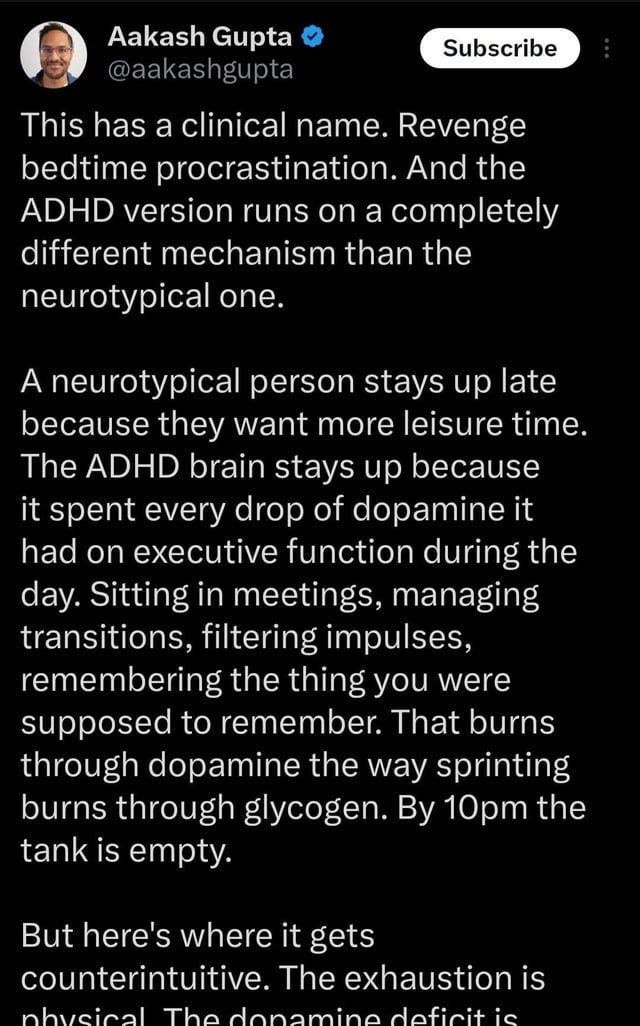
I have three problems with these claims.
Finite willpower reserves, also known as ego depletion, have thoroughly been debunked in the scientific literature.
It’s true that doing a difficult task for a very long time can make it harder to do more difficult tasks later on; my post-activity crashes are often caused by long periods of corralling my attention towards a single object without taking breaks. Still, I think this phenomenon is better conceptualized in terms of built-up negative emotion that must be processed and dealt with, instead of “focus is a finite resource that you must conserve.” It’s more psychological than biological. And of course, literal physical energy management is super real.
But the same cannot be said for willpower. We do not “spend” dopamine, nor is dopamine something you can “burn though.” ADHD brains do have some irregularities in how we process dopamine, but it would be a mistake to say we have “dopamine deficiency” or anything close; clinical dopamine deficiency is more like Parkinson’s than bad executive functioning.
And in general, most non-neuroscientist uses of the word “dopamine” found in the wild are completely wrong. You don’t get to say whatever you want and slap “dopamine” on the end. Even worse, using “dopamine” is often actively unhelpful; portraying our problems as if they have absolute one-size-fits-all causes, and thus solutions, really underplays the role of accounting for individual variability in trying to improve your life.
Revenge bedtime procrastination is roughly the same for everyone (and is also not that complicated).
Revenge bedtime procrastination is best conceptualized as an avoidance strategy. Maybe you’re avoiding going to bed because you felt like you weren’t in control of your day and want to do something, anything, for yourself before the day is over; maybe you have a hobby / tasks / activity you actually want to do for its own sake and only now have the time for it; maybe you worry about insomnia or really don’t want to be bored while trying to fall asleep, and thus will wait for the sleep pressure to build up so you can crash as soon as you hit the bed (me).
The specific reasons why will vary from person to person, but the cure is almost always some combination of the usual strategies: distress and boredom tolerance, self-reflection, and being better about managing energy and enjoyment throughout your day. So figure out your reasons why and tailor your cures to target them. If you can fix revenge bedtime procrastination’s upstream roots—and if the problem persists, commit to getting better at going to bed dissatisfied—I promise it will get better.
And yes, ADHD-ers are worse at these things than most people are. We’re particularly bad at boredom and distress tolerance. That’s why these skills are EVEN MORE IMPORTANT FOR US.
Revenge bedtime procrastination is not a clinical term.
That tweet, just like most other similar tweets, isn’t really trying to help you solve your problems. It’s a balm for people who’ve been called lazy for their entire lives, who were told that they could be great if only they applied themselves. It’s an attempt to assuage the fear that your struggles come from not trying hard enough.
That’s why it’s written in that pseudo-authoritative AI slop voice; that’s why it leans on “biology” and “dopamine” and posits physical explanations for all your problems; that’s why it claims that the ADHD version of revenge bedtime procrastination is somehow different. You’re different, it says. It’s out of your control; it’s not your fault. There was nothing you could’ve done about it. Everyone who told you otherwise was wrong, and you have nothing to feel guilty about. It sounds just like every other post about “dopamine” or “calming your nervous system” or any other pseudo-biological explanation for a common problem.1
And listen, I speak from experience. I tried so hard to be good when I was younger; I wanted nothing more than to apply myself. Hearing that from my teachers was a painful sting, implicitly denying the legitimacy of all my effort up until that point. At some point I got tired of trying to explain that I really was trying my best, even if you couldn’t tell, and simply gave up hope that anyone else would understand what it was like. For younger me, this tweet would’ve been a sweet salve of validation. “Finally, proof that it’s not my fault! It’s just biological! It’s a real clinical thing and not all in my head!”
But in reality, revenge bedtime procrastination sits in the same pseudo-science category as “rejection sensitivity dysphoria;” the problem it describes is very real and deserves serious and thoughtful consideration, but the attempted clinicalization of the issue is just supposed to make you feel like your symptoms are legitimate. It’s a natural response to feeling like your problems have never been taken seriously before—maybe if I give this thing an official-sounding name, people won’t brush me off by saying “have you tried trying harder?”—but it’s still fundamentally just an attempt to get other people to validate your own concerns.2
II.
I think my real problem with this tweet is that it’s just a bunch of excuses. We have real problems; ADHD is a disorder for a reason. You don’t need to go around pathologizing literally every offshoot symptom, nor do you have to claim that our issues are completely different from neurotypicals. The grain of truth in that tweet—that neurotypicals might have an easier time dealing with revenge bedtime procrastination than ADHD people—gets completely undermined by the straight-up lies. And they are lies! You can find all my factual corrections with like two Google searches, which is basically what I did!
And the kinds of people who say these things are the most annoying people in the world. They refuse to take accountability for any of their problems, preferring to talk in terms of fault or biology or neurology and deflecting responsibility. These kinds of people rely on biology because they’re insecure about the validity of their feelings and don’t trust themselves. It feels more legitimate if it’s biological, which makes them feel better about it, and I get it.
But it makes me really mad when people peddle these sorts of claims, because what you ultimately should be able to do is trust your own internal experience! You shouldn’t have to say some BS about dopamine to talk about revenge bedtime procrastination; you can just talk about it like a normal person. You don’t have to find some external reason to be the way you are, and doing so absolutely reeks of low self-esteem. And when people normalize straight-up lying about biology to make people feel better, they also normalize this fake-authoritative Tik Tok syndrome of medicalizing all of your problems because you’re not like the other girls or whatever.
Even more meta: at some point, you realize that the medicalization is simply not helpful. This kind of pseudo-diagnostic talk is understandable when you’re a teenager still trying to figure things out, but once you’re an adult, your identity doesn’t have to revolve around all the problems you have. You can just be a person with problems. The label is useful to get you the right kind of treatment. That’s it.
I know when it is and isn’t my fault. I don’t have to go to some random Twitter post to determine when I could or couldn’t have done better; I’ve calibrated my intuition and I now have a good sense of what problems are and aren’t out of my control. I’m also surrounded by people who trust me. I don’t have to resort to some made-up explanation about “dopamine” to explain that it’s my fault that the living room is a mess and I’ve been very tired lately but I will get to it tomorrow; I just say what happened and my friends believe me.
Even more importantly, I don’t put neurotypical people on pedestals either. Everyone struggles with motivation and attention regulation; we have it worse than most, but it’s not necessarily a different kind of problem, and their problems aren’t any less valid than ours. Dismissing neurotypical revenge bedtime procrastination as “they want more leisure time” while coming up with some stupid and fake “dopamine = glycogen” analogy is just cruel! Your problems don’t need labels to be legitimate, and you don’t have to put other people down to be heard!3
III.
The other issue is that the typical solutions work WAY more often than neurodivergent people like to admit.
I tried all the “natural” cures to ADHD when I was first going through the process of diagnosis. I improved my sleep, I ate healthy, I exercised regularly, I meditated and journaled and went to therapy, I got my socialization in and found hobbies I loved. None of these things cured me, nor did they have as positive an impact as medication (with the possible exception of therapy)4 but all of them actually worked. My quality of life significantly improved, and my life got easier to manage, which made it even easier to improve my life further, etc etc.
Yes, ADHD made it difficult to actually induce these lifestyle changes. I have a lot of thoughts on how to get better at these things despite having a mental disorder / illness / whatever, because the process is more difficult for us than it is for people without our afflictions, and I’ll probably write about them at some point.5 I would be lying if I said it was easy.
I am, however, saying that the solutions are often simple. The normie suggestions worked. And they work for most mental illnesses—I know for a fact that they help depression and anxiety—not because they’re generalized one-size-fits-all solutions, but because life is just easier when you’re generally healthy.
So get used to being bored, bucko. And maybe try to improve the rest of your life too. I know it’s hard, but I promise it’ll help.
Nervous system talk is tricky in that the sympathetic nervous system is actually responsible for the fight-or-flight response. It’s similar to dopamine in that the biology is actually relevant—it’s just either misrepresented or not useful. Go read any article about “calming your nervous system” and you’ll quickly realize that the solutions are all relatively generalizable anxiety treatments; that’s because your anxiety does not need a fancy biological explanation to be valid. Your feelings and intuitions are already a more-or-less accurate representation of what’s going on inside your head and body.
I would be remiss not to caveat here though: some disorders like C-PTSD are actually exceptions to this paradigm and require special handling / treatment.
I would also add that I used to identify with RSD, because I had a serious temper as a kid and never learned how to process my emotions properly; if ADHD is at all involved in rejection sensitivity, I would expect it to be something like of “is too easily bored and impulsive to regularly sit down and process feelings.” For more on RSD, check out this lovely reddit thread.
Miss Anthropy commented on my original note and put it so well that I’m just going to quote her here:
As a former mental health professional, I find it odd how popular it is to espouse an essentialist ND/NT binary, despite talk of the dimensional nature of diagnoses and the limitations of the DSM. ADHD means “in the bottom 10% of the population on executive functioning,” not “a person with a categorically different type of brain.” There’s no objective red line between ADHD and neurotypical, so it stands to reason that the same executive functioning strategies are likely to benefit both people with the diagnosis and people without it.
For more on this, read People Are Still Stumbling From One Misguided Narrative About the Medical Model to Another (ADHD Edition) by Awais Aftab.
The relative impact / superiority of therapy vs medication is weirdly contested in the literature. It’s also a false dichotomy, because you can and should just do both. Executive functioning coaching will probably help you take your medication and go to psych appointments more regularly, and medication will probably help you organize yourself long enough to book therapy, and most positive lifestyle changes will give you more energy and thus make it easier to try all the others.
Neurotypical people, bless their hearts, are occasionally really bad at giving advice about lifestyle improvements, probably because they grasped more of the basics intuitively and never had to think about them super consciously. A similar dynamic affects their small talk advice. Conversely, I feel like I am relatively decent at giving lifestyle advice, because I had to build all of my good habits from the ground up. But maybe that’s cope. Who knows?
To me that post also had an element of trying to apply a rich interiority to the ADHD experience, which neurotypical simpletons, who just want to have leisure time, could never understand. I don't go to bed, but for a much more interesting reason than anyone else, etc.
Generally I get just as annoyed as you do about the silly dopamine explanations. I'm sorry, I don't need psuedoscience to explain why I don't sleep, I already know it's because I work too much. But that's also kind of why I get the sentiment behind the referenced tweet. Like you said, there's a sense that others might take it more seriously if it's seen as some medical disorderor otherwise out of your control.
The advice and comments I get from people in my life is just as annoying as the psuedoscience. Yes I do realize I'm giving up an hour sleep tonight to play video games before bed, that's my choice to unwind. It's not like I was really going to get a full night's sleep anyway when I get home at 11:30pm and work the next morning at 6:30am. That's life, I'd like better, but sometimes you've just got to grit through it and hope you don't increase your dementia risk too much.