
No, we should not have seen Graham Platner's downfall coming
Beware of resulting

Don’t be so hard on yourself when things go badly and don’t be so proud of yourself when they go well. — Annie Duke.
I.
I’ve had thoughts on the Graham Platner debacle for some time now, but I’ve been mostly staying out of it because it’s a pretty controversial topic and I didn’t think giving my own personal take on the subject was worth contributing to more Democrat infighting.
You may be wondering who Graham Platner is. Here’s a TLDR.
The Democratic Senate primary in Maine is pretty important, since the winner goes on to challenge Republican Susan Collins in the general election. It’s a plausibly winnable election and the Senate is the most precarious chamber of Congress at the moment—it seems like the Democrats are easily going to win the House, whereas the Senate is more-or-less a coin flip—so the choice of candidate really matters.
Current candidates are incumbent Gov. Janet Mills and “oyster farmer”—we’ll get back to this later—Graham Platner. Platner polls well ahead of Mills, but is still a risky candidate due to being a political novice and having a few scandals under his belt.
The scandals keep accumulating, eventually rising to the level of rape accusations. Platner—and by extension Maine Democrats—and by extension national Democrats—are all in a tough spot.
Oyster farmer is in quotes because he does actually own an oyster farm, but it also does seem like his mother’s restaurant is his chief customer. From Politifact:
Platner’s income from the oyster business is unclear. Under the “compensation” section of his personal financial disclosure, the one entry listed as providing him more than $5,000 annually is from his mother’s business, Ironbound Restaurant and Inn. The description is simply “oyster purveyor to restaurant.”
But fascinatingly, Politifact is quoting this statement in support of the idea that Platner’s oyster farm is real. The statement they’re factchecking is the idea that the business is fake, and they rule that statement to itself be False.
Robinson said the oyster business was “totally fake.”
Public records show that Waukeag Neck Oyster Co. has been registered with the state since 2018. Platner received a grant in 2021 to buy business equipment.
The business applied for and in 2021 obtained approval from the state to farm oysters. Waukeag Neck also has a social media presence that predates Platner running for office.
We rate this statement False.
And like, sure, I guess Robinson is strictly lying about this. But here’s another statement that Politifact is implying to be false:
At midnight on Primary Day, the National Republican Senatorial Committee released an ad aimed at Platner: “Graham Platner runs a hobby oyster farm, whose only customer is his mother’s restaurant.”
Uh, is this strictly false? I’m not so sure. If my parents paid me $5,000 per year to run this Substack, I feel like it would still not be a “real business” or whatever. Yes, I spend a lot of time running this thing and have a few paid subscribers who aren’t my parents—if that’s you, thanks for reading, you’re awesome—but I definitely consider myself a hobbyist at most. And obviously Platner has invested more time and energy into his oyster business than I have into this blog: as Politifact points out, he has a license and everything, but the whole thing still kind of reeks of stolen oyster farmer valor.
Is the legitimacy of Platner’s oyster farm really all that big a deal? Honestly, nah. But Politifact’s rush to defend Platner betrays the greater rush of the Democrat party to ignore all of Platner’s shortcomings; there IS a real question to be asked here, which is whether Platner is lying about his oyster farmer business. Dismissing the question out of hand does more to erode your own credibility than anything else.
And more generally, dismissing scandals with a simple “but he’s changed!” leaves you even more vulnerable to future scandals—because if new scandals break, people will rightfully question your judgment.
II.
This is the thrust of Jerusalem Demsas’ latest article in the Argument. To quote her directly:
Judgment is the discipline of noticing when a pattern has become impossible to ignore. Getting a Nazi tattoo doesn’t make someone a rapist, nor does cheating on your wife prove you’re a Reddit troll. But judgment is the practice of finding the signal in the noise and knowing that bad acts are not randomly distributed; they are correlated. And time and again, Platner has proven himself to be a bad person who you shouldn’t trust with power.
I find Demsas’ argument more or less convincing. Yes, it was pretty unnerving to see Platner face a series of increasingly serious scandals, and anyone who said otherwise is either delusional or a liar; that’s precisely why I’ve been staying away from the topic.
To explain, here’s a very rough sketch of how my opinions on Platner changed over time.
1. Anonymous offensive comments on Reddit.
I mean, I remember when James Gunn got cancelled on Twitter, and he seems fine these days. But also, some of Platner’s comments seem pretty bad. For example:
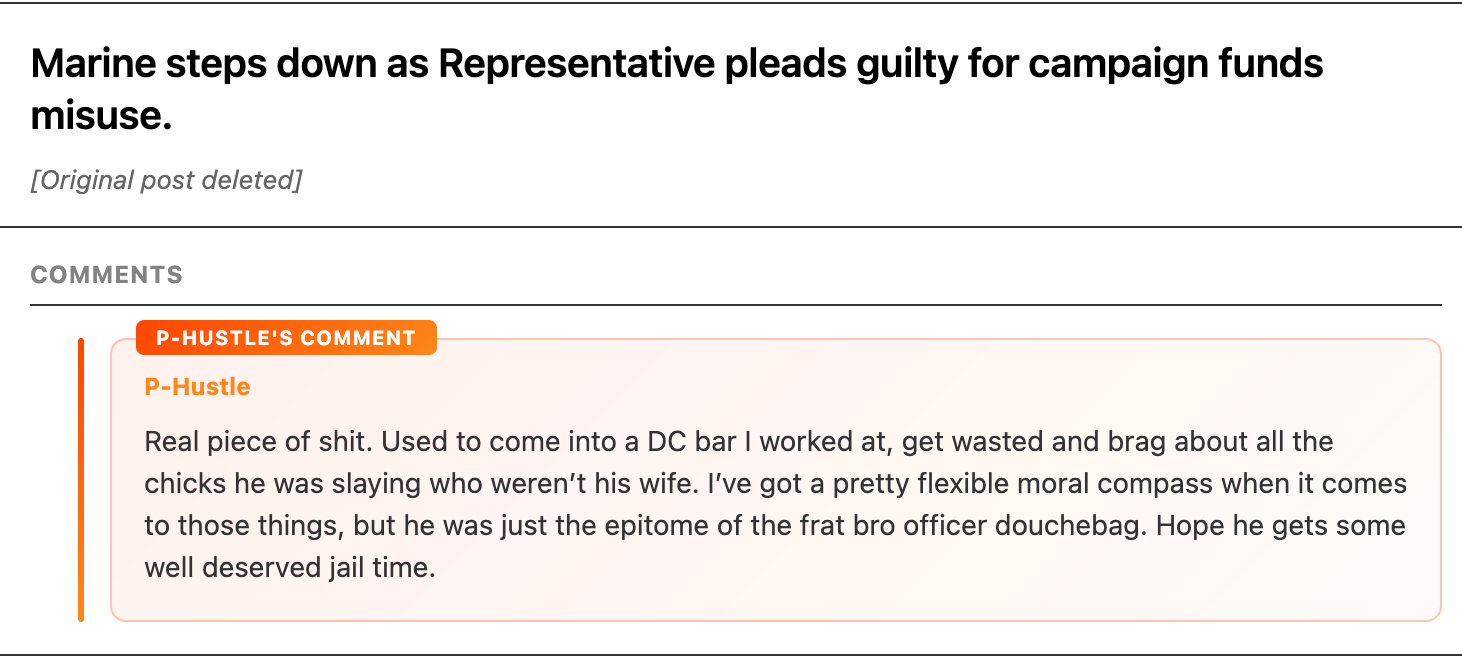
Flexible moral compass, huh. Not exactly a quality I want in a U.S. Senator.
Also consider this comment of his:
Holy fuck, how about people just take some responsibility for themselves and not get so fucked up they wind up having sex with someone they don’t mean to? Men and women, you make a choice to consume enough of a substance to lose your self control. So if you don’t want to be in a comprising situation, act like an adult for fucks sake.
This is some pretty horrible victim-blaming stuff. Yes, you’re more vulnerable to assault when you’re drunk. This does not mean you deserved to be raped. And yes, it’s rape—not sex—because you can’t give consent once you’re sufficiently intoxicated.
So, yeah. This sucks. I strongly disagree with Platner’s statement on the subject. But crucially, so does he: he now disavows his Reddit comments and says he wrote them while he was going through a dark time. This just isn’t enough to sink him for me, especially given the gravitas of our current situation. We need to win the Senate: if he’s really the stronger candidate, I’d be willing to bite the bullet and support him.
Ah. I guess that’s where the flexible moral compass thing comes in. Once again, bad taste in my mouth. But this is a personal failing on Platner’s end, and it doesn’t necessarily speak to his abilities as a politician: this is far from the first federal-level political scandal. A few presidents come to mind too…
And also, I’m inclined to listen to Platner’s own wife on the issue:
“It makes me really angry, disappointed,” Platner’s wife, Amy Gertner, said in a direct-to-camera video Platner’s campaign released Saturday night. “And I find it really shameful that there’s a group of media outlets and people who are willing to spread gossip instead of talking about real issues that Graham is running on.”
So, yeah. I feel even worse about him than I did before. Cheating sucks and is an indictment of one’s moral character. But this still isn’t enough to sink him for me. Politicians are often liars with flexible moral compasses—sometimes that’s just what it takes to get into our highest offices. Of course this isn’t an ideal situation, but given the gravitas of our current situation, I’ll continue holding my tongue.
3. Nazi tattoo.
What the hell?? Where did this come from??
Yes, apparently Platner had a Totenkopf tattoo. And no, I don’t believe that he didn’t know what it meant. To quote John Ganz,
What I find very frustrating about politics is that it forces you to pretend you’re stupid. Case in point: Graham Platner’s Totenkopf tattoo—we’re supposed to believe he didn’t know what it was when he got it. Come the fuck on. First of all, the guy is an edgelordy Reddit autodidact type with a lot of opinions. This is precisely the demographic that knows all about militaria and WWII history. Not only would he know what it was, but he would also be proud to know what it was: such semi-obscure knowledge is the coin of that realm. Second, he was a U.S. Marine. Military guys know what that symbol is. And military guys like to be menacing and outside the norms of civilian society. It’s very edgy, but it’s still not a swastika or SS lightning bolts. It rides the territory on the border of taboo. Perfect!
Ganz writes this in a larger article arguing that Graham Platner is “a type of guy.” It’s great, and you should read it in full, but I’m going to quote his conclusion here because I think it sums up my thoughts perfectly.
But it’s why I feel ambivalent about Platner: I don’t think he’s a very serious person. There’s an air of buffoonery about the whole thing. I’ve met many of these private-school Don Juans in my life, and I don’t particularly like them. They are usually real sons of bitches. Now, that’s not necessarily a bad thing: seriousness itself, the sheer givenness of society’s norms, has to be rejected if you are going to be an authentic person who thinks for yourself. But hopefully, then you ethically dedicate your life also to the freedom of others, not just your own. Does Platner give a shit about anybody except Platner? I guess I don’t buy the performance. Can an adventurer be a good guy to have on your side? Sure, at least they are not cowards. But I don’t entirely trust him. Maybe, because he’s certainly lying about the tattoo.
I don’t think Platner is actually, literally a Nazi. It seems to me like he is (or at least was) just an annoyingly edgy Redditor-type. That’s still very far from my ideal candidate for public office—but once again, given the gravitas of our current political situation, this still isn’t enough to sink him in my eyes.
But we’re really close, dammit. A single incident does not a bad guy make. But we’re at not one, not two, but three pretty serious incidents here. If a friend of mine did any of these three things, I would see them very differently and likely begin to distance myself from them just out of sheer disgust. So if any of the above was too much for you, I respect the hell out of your decision. I’ll hold my tongue for now, but one more scandal and I’m out.
Okay, okay. Line crossed. Pack it up everyone, we’re done here.
Donald Trump’s sexual assault accusations were among my biggest red flags in his initial campaign, and I won’t make an exception for anyone who faces serious sexual assault accusations. I don’t care how based and woke and leftist their policy positions are; this is not the kind of person I want representing America in the Senate. If you think this is fine, we’re gonna need to have a serious conversation about the importance of taking sexual assault accusations seriously, along with the standards that we should hold our elected representatives to. Rape goes beyond the simple bounds of “scandal” and enters “if he actually did it, this is an evil crime and he should face time” territory.
So, yeah. Now is the time to jump ship, if you haven’t already.
III.
Eagle-eyed readers might be wondering: earlier, I said that I found Demsas’ argument “more or less” convincing. We just covered the “more” bit. But where does the “less” come in?
To that I say: good question, hypothetical reader. The reason I said “more or less” was because I think Demsas overreaches in her argument, and in doing so falls victim to “resulting.”
Yes, that quote from the beginning was relevant. Don’t worry, I’ve also forgotten what it says by now, so I’ll paste it again here.
Don’t be so hard on yourself when things go badly and don’t be so proud of yourself when they go well. — Annie Duke.
The basic gist of “resulting” is very simple:
In games with deterministic outcomes, like Chess, results are everything. As such, if you lose a game, you know you made a mistake somewhere and should change something next time. And if you win a game, you know you did a lot of things right, and would probably do well to learn from your victory.
In games of chance, probability, and intuition—like poker, where the term “resulting” comes from—things aren’t quite so simple. Because of the way chance and probability work, it’s very possible to make the right decision given the information you have, lose anyway due to chance, and “learn” that the right decision is “actually” the wrong one. And crucially, resulting works the other way too: it’s very possible to make the wrong decision, win anyway, and “learn” that the wrong decision is “actually” the right one.1
So, when playing a game of chance, you would do well not to overfit on your losses OR your victories. It is possible to commit no mistakes and still lose. That is not a weakness. That is life.
I use this concept all the time and it’s made a HUGE difference in how I view my decisions in life. And I bring this up because I think Demsas is resulting in her article.
Regarding Platner, Demsas dedicates an entire section of her article—titled “You could have seen this coming”—to the idea that we could’ve seen this coming. (Shocker.) She says:
Morally defective people are not necessarily stupid; they could be very clever. But their defects lie in errors of reasoning, like failing to truly internalize that other human beings are people of equal moral worth or concocting elaborate rationalizations.
This type of error has consequences that leak into jokes, relationships, professional conduct, political judgment, and yes, anonymous Reddit posts. These are the sorts of errors one should expect to bear other poisoned fruit.
Virtue is not a decorative, prissy quality that hinders you from being savvy. No, virtue is what comes from reasoning well and having the will to follow through on that reasoning. There will be other Graham Platners, other people who seem like they are on your team but for some pesky red flags. The point of good judgment and all that annoying virtue is that it prevents you from making the mistake of trusting them.
I have two gripes with this take.
First, Demsas seems to imply that anyone who didn’t jump ship at the first sign of Platner’s scandals has bad judgment and/or isn’t virtuous. I think this is completely leaving out a third category of person—the John Ganz’s of the world, who are aware that Platner is not the kind of guy you want as your friend but are also open to the possibility that a truly “big tent” may sometimes mean having to support people who you find personally distasteful. It’s not immediately obvious to me which is right, and I think the only correct play here is to make an uncomfortable decision either way and wait to see how the cards fall before fully committing to a given position—especially as a pundit.
Second, I think Demsas is very much resulting here, at least in regards to how early one should’ve jumped ship from the Platner campaign. In her article, she writes:
Yesterday, Politico published damning new rape allegations against Graham Platner, the Democratic nominee for Senate in Maine. The allegations are corroborated with messages that were sent before Platner rose to prominence and from a source who had a documented relationship with the candidate’s accuser. Pundits and politicians who had previously stood by Platner through earlier scandals began to rescind their support, sensing that this might be the final straw.
I think this entire story has to do with bad judgment: Platner’s, yes, but also that of his defenders and anyone else who equivocated their way to this moment.
I disagree. Listen, you can draw the line wherever you personally want, but the balance between “we need to win this Senate seat for the sake of our democracy” and “I don’t trust Platner and think he’s a liar” is a tough one to strike. If you lean too hard towards the former, you risk filling the Senate with evil people who are ostensibly “pro-democracy” but are in reality liars who are willing to say and do whatever it takes for them to gain power. BUT, if you lean too hard towards the latter, you risk not running some of your best-polling candidates because you’ve purity-tested them out of the competition, and ceding Congress to the Republicans in the process.
I know where my line is, and so does Demsas. In most aspects of my life, I tend towards virtue ethics, but when it comes to politics, I’m a consequentialist through-and-through;2 in practical terms, this means that I’m much more willing to bend moral rules when the stakes are this high. I’m not willing to argue that the line should be in the exact same place regardless of the context surrounding the race in question.
And this leads me to my final point of contention with Demsas:
In nearly all circumstances, it’s good to think the best of people, but picking 1 of the 100 people to work in the U.S. Senate is one of the few exceptions that demands a different standard. The standard for a friend, colleague, or sibling may be “Can I imagine a sympathetic explanation for this behavior?” but the standard for the person making consequential policy decisions for 340 million people is whether the available evidence suggests the habits of mind we should want near power.
Under normal circumstances, I would agree with her. If there were another viable candidate who had a similar chance of defeating Susan Collins, I would’ve jumped ship long ago. But up until very recently, Platner was the best candidate—and did not yet have serious sexual assault accusations levied against him, at least to my knowledge—and so I was willing to reluctantly support him.
And to be clear, I do think that many of Platner’s defenders said asinine things that did demonstrate bad judgment. Demsas’ article is full of these people and their sayings. What I am saying is that it was possible to be a reasonable Platner supporter, so long as you were reluctant and cautious—even if it is no longer possible to be a reasonable Platner supporter. At this point, the calculus has changed; now that the accusations have been revealed, Platner is now a much weaker candidate and should step down, even at the risk of reducing our chances of winning a Maine Senate seat. I just don’t think Demsas’ position was obviously correct the whole time—and I don’t think all past Platner supporters were necessarily making errors of judgment.
In games of chance, you make the best decisions you have with the information you have, and you update your decisions as more information is revealed. Decisions aren’t bad if they turned out to be wrong, they’re bad if they were foolish given the information you had and nothing more. You shouldn’t disparage people for changing their minds in response to new information, nor should you be overly self-congratulatory when you happen to be right.
IV.
Finally, I’d be remiss not to mention Freddie deBoer’s article on the subject.

Freddie’s argument is pretty simple: the scandals against Platner are perfectly engineered to sink his campaign, and they were probably shaped to do so by the mainstream Democrats.
Ratfucking isn’t just trying to hurt your political opponent’s campaign; that’s electoral politics. Ratfucking is a covert process built on plausible deniability, tactics that no establishment politician or campaign is going to publicly acknowledge as their work. Think of the planted story timed for maximum damage, the dirty trick disguised as spontaneous misfortune. The essence of ratfucking is not that the damaging material is necessarily false. It’s that the sabotage is engineered - sourced, timed, and laundered through credulous media intermediaries to produce an outcome that the saboteurs could never achieve openly. By that definition, the cascade of media revelations now engulfing Maine Senate candidate Graham Platner is as pure and plain a case of ratfucking as I can remember… and almost certainly engineered by the Democratic establishment, which cares more about control of the party than winning the Senate.
To be honest, I completely buy this argument. This seems like exactly the kind of thing that Chuck Schumer’s camp would do. They’ve come pretty close in the past.
But I don’t bring this up because I think we should be supporting Platner. Yes, it may be a ratfucking, but that doesn’t absolve Platner of actually committing those actions. In fact, I bring this up for the complete opposite reason, which is that there HAVE to be better candidates out there. One of the reasons I was so excited about Zohran Mamdani is because he by all accounts seems to be a fundamentally decent guy!
And I can guarantee you that the Democratic establishment was trying just as hard to ratfuck Zohran Mamdani as they were Platner. They threw their support behind Andrew freaking Cuomo, for God’s sake, we all know for a fact that they would’ve excoriated Zohran Mamdani if he had even a whiff of Platner’s scandals, but they didn’t uncover anything about Zohran because there was nothing to uncover! Mamdani is the kind of politician I hope to support, not the guy with some really horrible Reddit comments with a history of cheating on his girlfriend and also a Nazi tattoo.3
Sometimes you have to hold your nose and close your eyes because this is politics. I was always vaguely anti-Platner even while I was still supporting him before the sexual assault allegations: that’s just how it goes. But come on, man, you don’t have to go around defending horrible people just because they’re the enemies of your enemies.
And the worst defenses of Platner that I’ve seen are those along the lines of “but the other side does it too.” Yes, guys, it’s equally bad when everyone does it!!4 Do you seriously only follow your moral compass if the other guy is too??
Anyway, this whole thing sucks and I want to stop thinking about it. Support decent people when you can, do the least harm / most good when you can’t, and above all else please stop being so confident about your takes on really complicated topics.5 The world is hard and politics is crazy and we don’t have to make it any harder than it has to be.
For an example of the former, consider a simple game of chance. The rules are simple: you pick a fair die and roll it. If you roll a six, you pay Elon Musk $10. If you roll anything else, Elon pays you $10. You can play the game as many times as you’d like.
Should you play? And if so, how much should you play?
I think the answer here is straightforwardly “yes, and as much as you want / until you feel bad about taking more of Elon’s money, i.e. never.” There’s a 5/6 chance that you make $10 from this game, and a 1/6 chance that you lose $10: your expected value in this game is overwhelmingly positive. But you can imagine a world in which someone agrees to play, loses three rolls in a row due to sheer dumb luck (1/216 odds is bad, but it’s not THAT bad), and immediately quits the game out of frustration, thinking “man, I never should’ve played that game at all.”
This would be an incorrect lesson to learn—you made the right decision and just got really unlucky—but stuff like this happens all the time. More importantly, it’s easy to see the right answer in this toy example. It’s much harder to avoid this mistake in a game like Poker, and hardest of all to avoid this game in life.
For an example of the latter, consider a one-time lottery winner who gets addicted to gambling.
I got this phrasing from a recent Daniel Muñoz interview with Professor Ian Shapiro, political philosopher and author of After the Fall.
[PRE-POST EDIT]: In the time between writing this post and scheduling it for publication, Mamdani decided to call on Platner to drop out of the Maine Senate race. You can’t make this stuff up.
It seems like the split is 60% Republican, 40% Democrat, and 97% male, at least in Congress. And obviously the 97% male statistic is the most striking of the three, but unfortunately this is going to have to be a topic for another time.
I am not immune to this and apologize for my past instances of unwarranted smugness or snark: please call me out on it if and when you see it.
Jerusalem wrote a (very prominent and widely discussed) article a month ago whose thesis was "Graham Platner is a scumbag Mainers should vote for." It made very clear that (in June 2026) Platner was obviously a superior candidate to Collins and his many personal failings were not a sufficient reason to reject him in a two-candidate race. But that we should take the 'lesser evil' logic seriously and remember that someone with this track record really does seem pretty terrible and we should lament being in a situation where this is the best option. Because we had plenty of information, long before this week, to support the thesis that he was in fact a scumbag.
Basically, I think she's been pretty consistent and clear that Platner is/was bad news, while also being consistent that the *most* important objective is for any Democrat to win the race.
Seth Masket also had a good piece back in the fall that someone who had a Nazi tattoo for decades and then lied about it repeatedly (in very obvious ways) is bad news, not just because of the tattoo (which was very bad!) but also because it reflects extremely poorly on his judgment and temperament. Someone like that is significantly more likely than the baseline candidate to have other skeletons in the closet, and it's dangerous to hitch yourself to a campaign that could go completely off the rails.
Anyone who was 100% certain that something like this would come out was obviously over their skis. But 'this is a dangerous bet, and do we really need to take the risk in order to get this specific guy?' was a thoroughly reasonable position to hold. And I think the burden should have been on the defenders the whole time to justify their position, not the other way around.
I don't even disagree with this, but Democrats never allowed the same grace for Republicans. If you support a Nazi(a guy in the same party as a guy who made a gesture that may have been a Hitlergruß or may have been him waving), that must be because you love Nazis, not because you still find his policies better than the alternative. And then they turn around and say that having a Nazi tattoo means nothing, and it's fine to support Platner anyway. Forgive us some amusement at that.