
Co-Star Advice Tier List
The good, the bad, and the ugly

The Buddha’s teaching asks us to reflect on what we already know or on our principles, then to verify them with people whom we respect and value, and to proceed from that intuitive sense of certainty…He starts where they already are—where every path should start.
Excerpt From Turning the Wheel of Truth by Ajahn Sucitto
As a kid, I used to love astronomy—the planets, the other celestial bodies, the physics, everything. Accordingly, for as long as I can remember, I’ve been an astrology hater (so unscientific!). But as a freshman in college, I wanted to fit in with all of my friends, so I downloaded the astrology app CoStar. CoStar still sends me advice every day!
Now, if you know me, you know I love advice. I like writing advice, writing about writing advice, writing writing advice, and writing about writing advice. Naturally, I already had a lot of thoughts about astrology advice. But surprisingly, I found myself appreciating some of these notifications, even as others disappointed me. At Virginia Weaver’s suggestion, I decided that this was a job for the good old tier list.
So, over the past few weeks, I’ve screenshotted every advice notification that CoStar has sent me1. I’m going to be ranking them on a tier list and giving each a letter grade based on nothing but my own unprofessional opinion: S, A, B, C, or F. These letter grades will be accompanied by some brief commentary on each of the pieces of advice. Finally, I’m going to wrap up with my concluding thoughts on CoStar itself.
Let’s get into it!
S: The Gold Standard
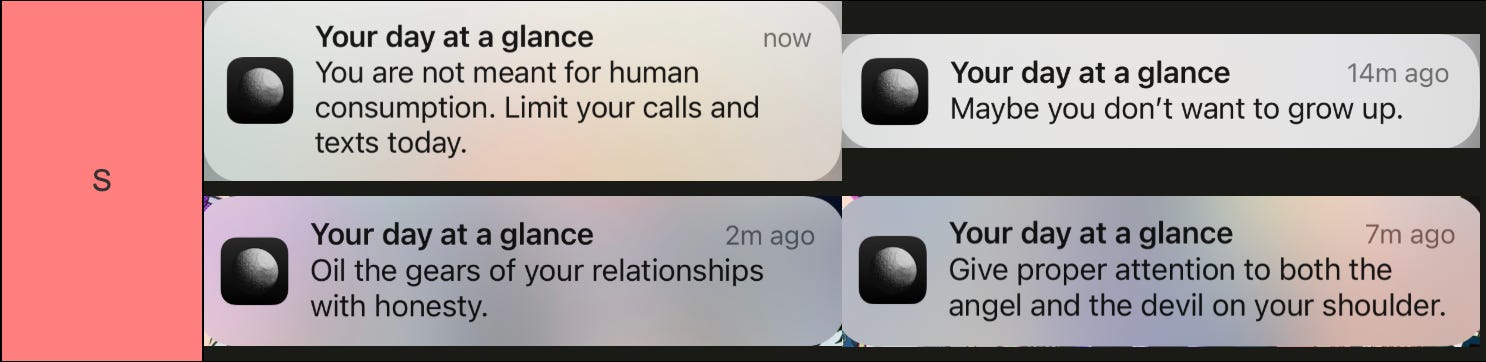
We’re starting off strong with four pieces of advice in the S Tier, which is honestly more than I expected when I started this experiment.
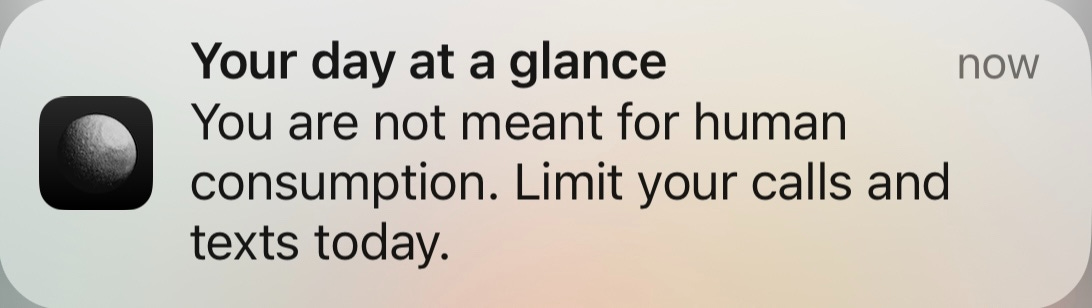
I think the advice itself is fine, but it came at a time when I REALLY needed to hear it. I was swimming in my Substack feed and even made a jump to Twitter because I wanted more information on some particularly nasty current events, and this notification shook me out of it. Thanks, CoStar.

I think a lot of people—myself included—rush themselves into being mature or adult or thoughtful before their time. There’s nothing wrong with trying to do that, but it’s nice to remember that resistance isn’t something that necessarily has to be defeated.
Try as I might, I can only get older. Maybe I should let it happen at its own pace.

This is something I already knew, but it came at the perfect time for me—I was being avoidant and I knew that I had to stop being avoidant but I was sort of keeping it under the surface and ignoring it. This notification made me think about what I was avoiding and I ended up having a good, frank conversation that needed to happen. Good stuff.
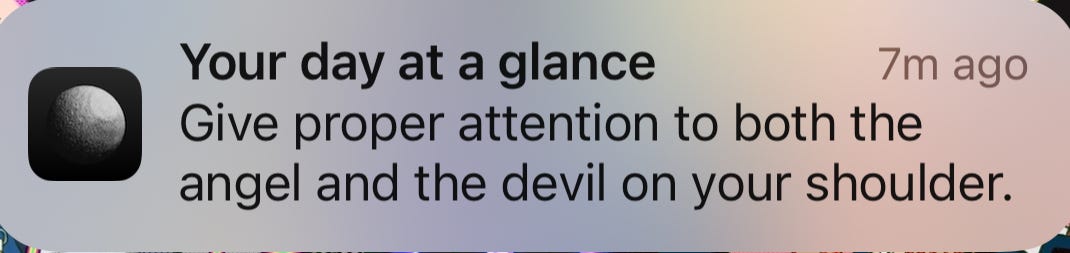
Like the best advice, this notification was vague enough to be generally true but specific enough to be personally useful. I fall into this trap a lot—when deciding how I feel about something, I often paint everything as fully positive or fully negative, and I rarely try to consider both at once. I think this is particularly true when it comes to breaking cycles; I often focus too much on the angel (the thing that I’m trying to accomplish) at the expense of the devil (why I’m in this cycle in the first place), and it makes changing much harder.
A: Still pretty good
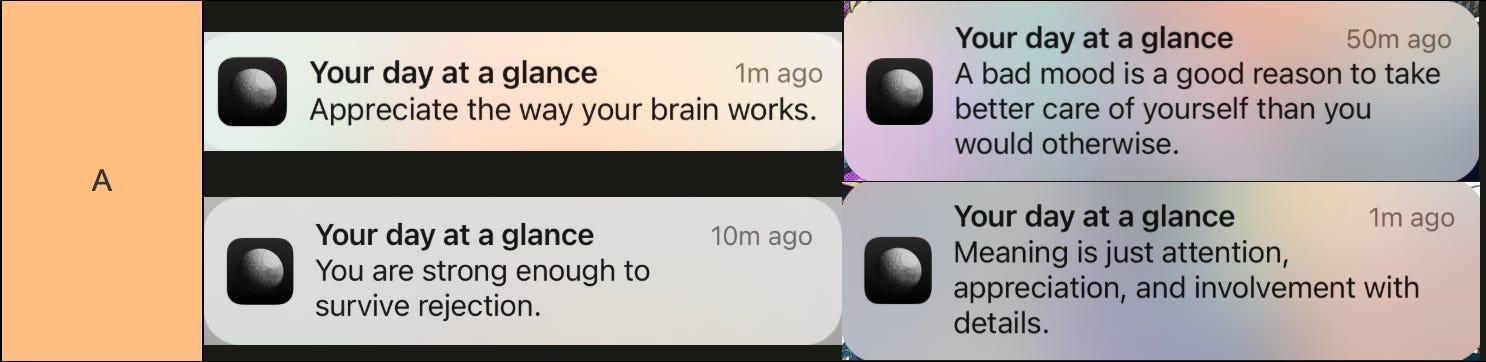
Next up, another four for the A Tier.

I’ve been very frustrated at my brain for as long as I can remember—comes with the territory (read: ADHD). I hate it when people say that ADHD is a superpower, but this notification was a nice reminder to exit my self-flagellating funk and remember that I am a human being with good qualities too!
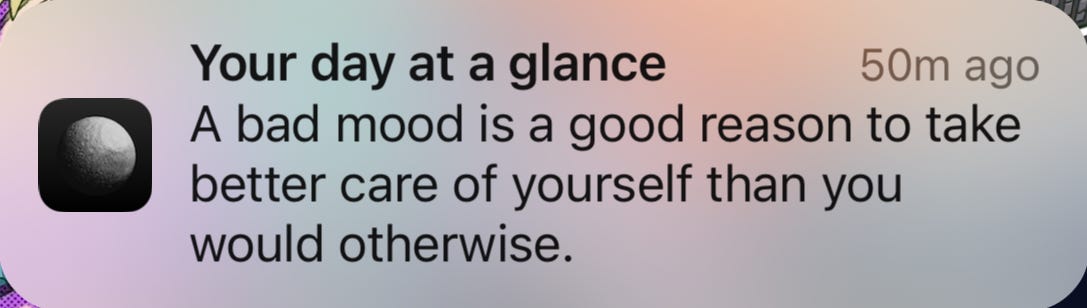
This is in the A-tier for one reason: I don’t think that you should be taking worse care of yourself when you’re in a good mood. In fact, that’s exactly the sort of thinking that leads to boom-bust emotional cycles that make you a menace to everyone else around you. That being said, it gave me good motivation when I needed it, so in A it shall stay.

Ah wait hang on wrong one
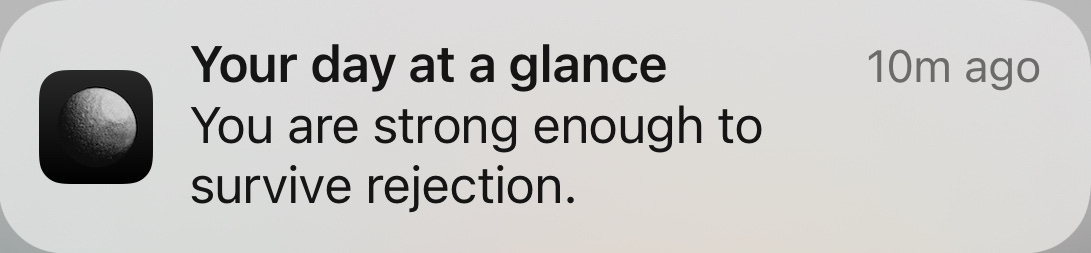
Rare is the person who does not need to hear this! I appreciate this piece of advice—rejection is hard, and your strength does not necessarily make it easier but it does make it more bearable. Get after it!
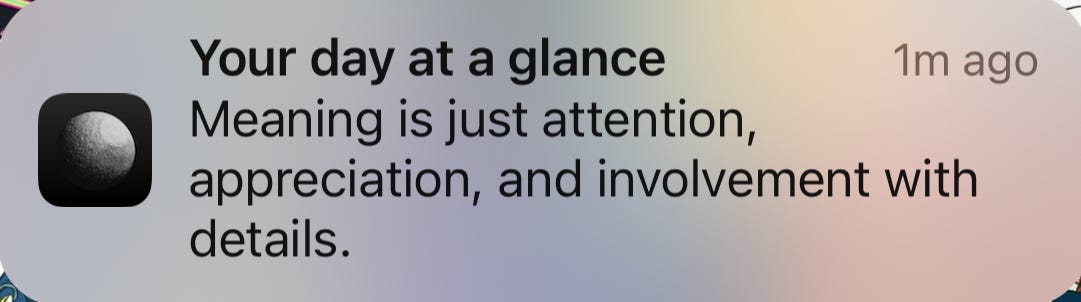
This is in A because meaning is probably not “just” anything. Still, attention, appreciation, and involvement with details are all things I have been lacking lately. I’ll keep this in mind.
B: Fine I guess
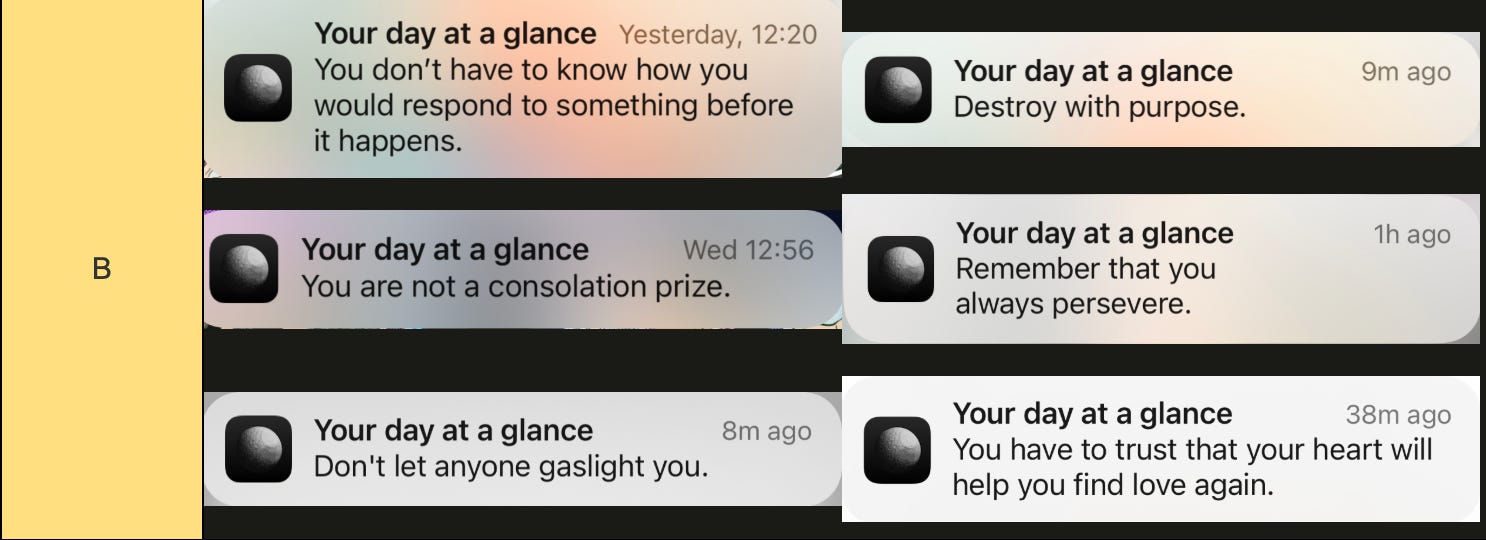
There are a lot of Bs and I don’t have much to say about most of them.
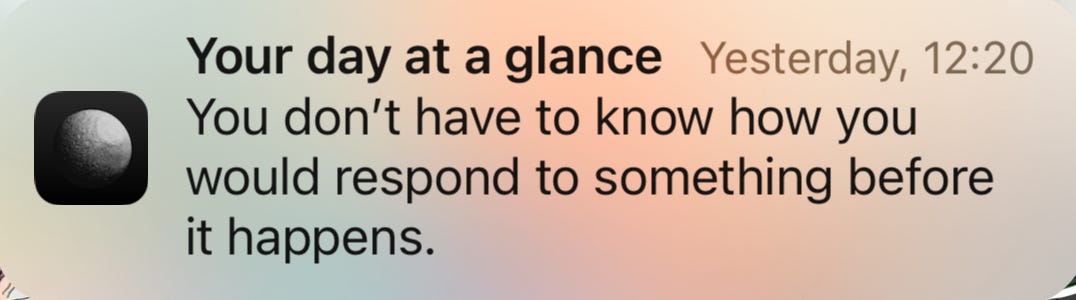
Plans are good. Maybe an anxious overthinker type needs to hear this, and yeah sometimes I need to be more comfortable with uncertainty, but it’s very possible to become too laissez-faire about your life. You don’t have to know, but sometimes it’s just a good idea.

I can construe this to mean something good (purposeful destruction is the opposite of hoarding after all), but it doesn’t feel very meaningful to me. Still, it probably makes sense to someone who really does not like destroying things, so it’s a solid B.

I mean yeah sure why not. This sounds like an obvious loading screen tip. Still, obvious is better than bad, so I won’t drop this to C. B it is.

I’m sure someone needed to hear this but honestly man I’m chilling. If you feel like a consolation prize, my heart goes out to ya. That’s tough.
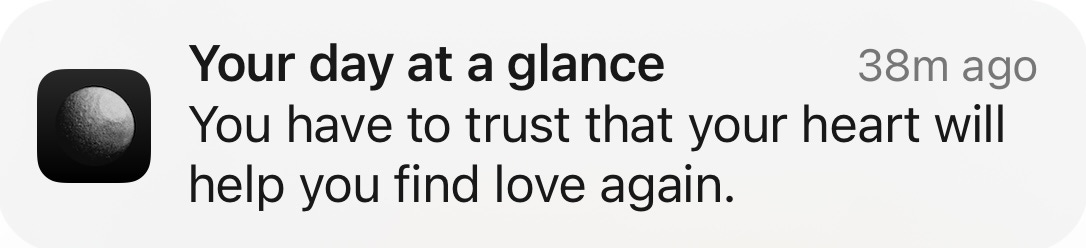
Again, maybe someone needed to hear this but not me. And again, if this resonates with you, my heart goes out to you. That’s rough, buddy.
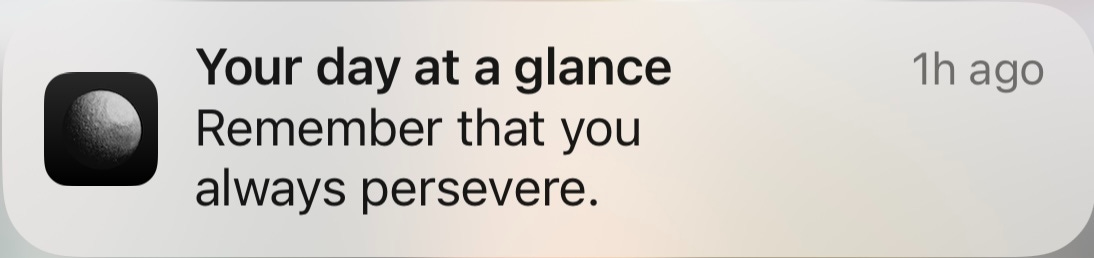
At times, advice of this kind has been very motivational for me. Right now, I’ve internalized it to such a degree that it no longer makes me feel anything. I know I’ll make it—I always do.
C: Meh
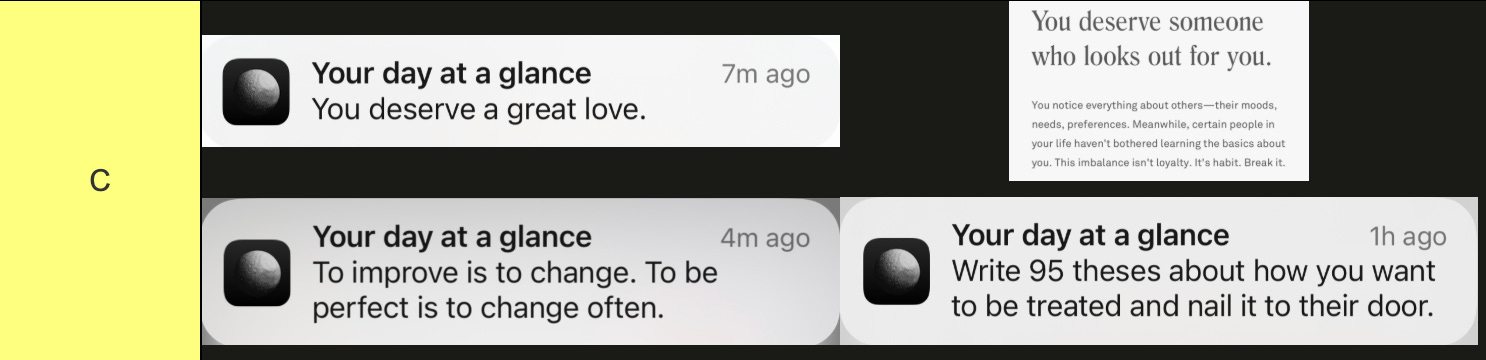
C Tier might genuinely be the most interesting tier of advice. I feel like these statements have an even chance of making things better, worse, or literally not changing anything: in other words, this advice is EV-neutral. These four pieces of advice still pass, but only in the sense that they’re not explicitly failures.

This didn’t move me at all. I doubt it would move anyone who needs to internalize their worthiness of love. Also, it probably contributed to puffing up some obnoxious person’s ego, and we don’t need any more of that. Next.
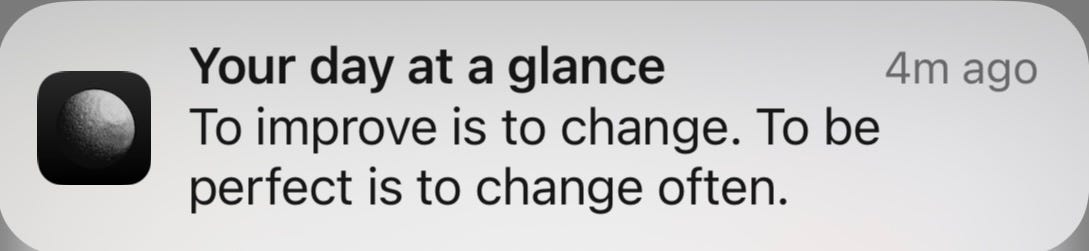
Honestly, this is just an annoying witticism. Change is only good or bad depending on whether the new state you are changing into is better or worse than the old state. Also, I think being perfect is usually defined as being as good as possible, so I guess CoStar decided that changing the definition of a word was profound enough to warrant a notification. Whatever.
This next one’s a combo:
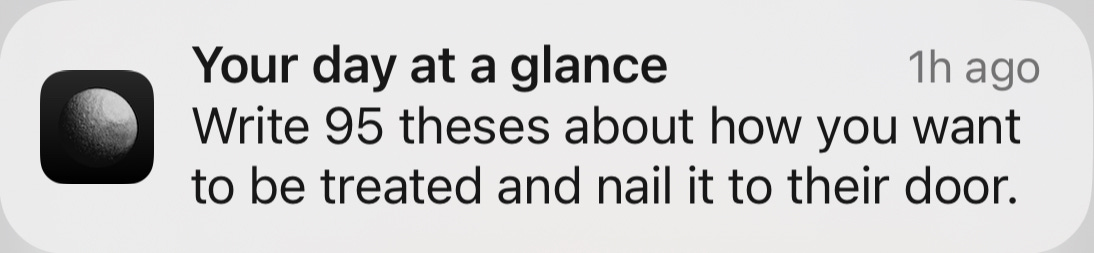
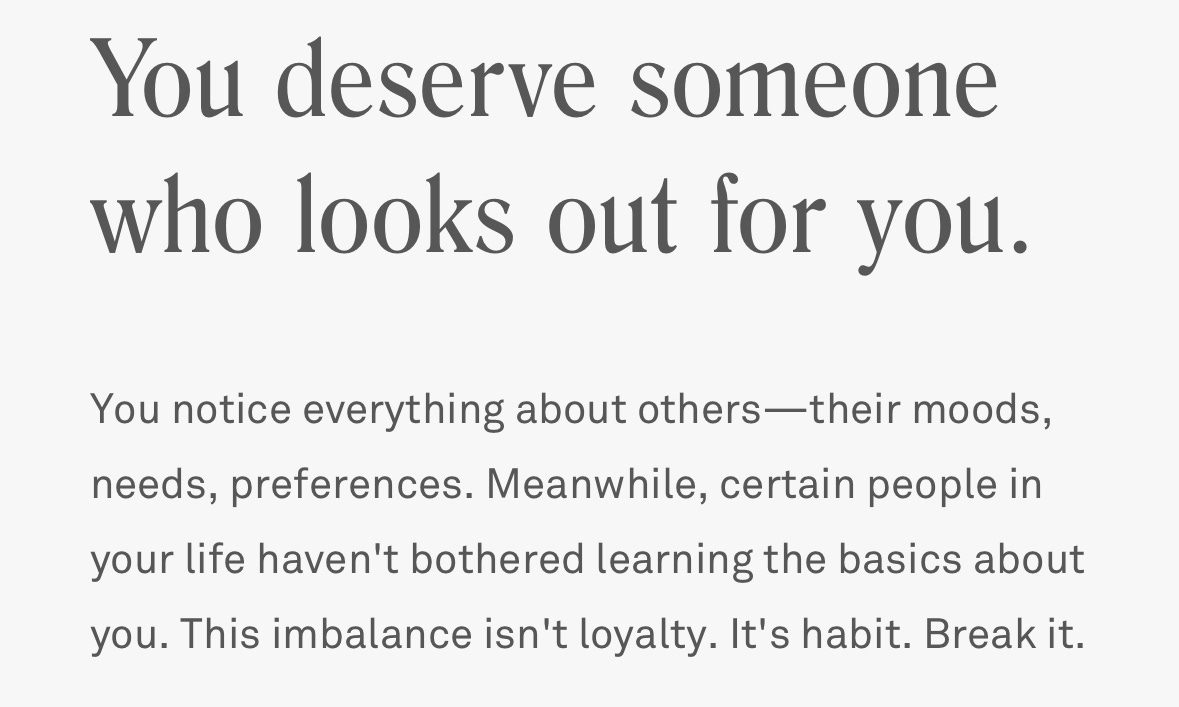
This is entirely dependent on the temperament of the recipient. Some people need to communicate more, and some people need to stop making excuses for other people. Accordingly, these two have like a 50/50 chance of exacerbating problems or helping people.
The thing is, I suspect that a lot of people who really shouldn’t follow these pieces of advice will be very receptive to it, mostly due to the confident and assertive nature of the advice. If someone thinks 95 is a good number of theses, they should probably just find a new partner. And if someone is constantly complaining that their partner doesn’t look out for them, one begins to wonder why they don’t just leave and find someone better (alternatively, if they go through partners on the regular, one begins to wonder if they’re the problem).
Anyway, onto the final round
F: Trash
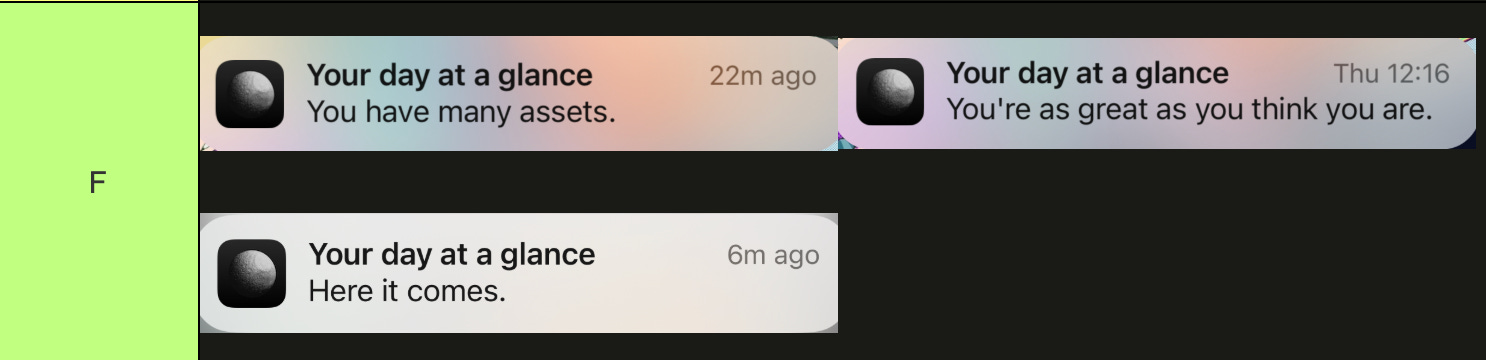
Only three pieces of advice are bad enough to warrant an F.

One of my biggest pet peeves is fortune cookies that don’t actually predict any fortune. This notification is the same principle, except it’s applied to advice instead.
This probably actually means something like “be grateful for what you have / remember your existing resources and use them”. I guess that’s fine, but that did NOT come through in the screenshot, and I didn’t click on the app to learn more because the single phrase kinda sucked. Boo.

Maybe someone needs to hear this. I certainly don’t. Don’t puff up my ego further, please.

This is actually just an ominous prediction. I’ve been stressed and anxious recently, so this was NOT something I needed to hear.
Maybe someone needs to get off cloud nine and be on their guard, but I don’t think that kind of person will listen to this type of weird and nonspecific doom-fortune. Please do not say this to other people.
My Conclusion
So, after all that, time to deliver my verdict on the question: should you download CoStar?
Nah.
I included the quote at the beginning for a reason: advice isn’t supposed to be about the advice-giver, and it’s really hard to give advice without knowing the other person. And as a purveyor of online advice myself, I think about this a lot. It’s not enough to just write advice: you also have to make sure that your piece will attract the kind of person who needs to hear the advice and not attract the kind of person who doesn’t need to hear the advice.
As a reader of online advice, this problem is even trickier: Without a particular reader or audience in mind, online advice varies heavily in truth and utility. Accordingly, a lot of my time is spent finding advice and purveyors of advice that seems reliable, trustworthy, and also relevant for my personal situation. The worst kind of advice is that which is correct and well-written, but wrong for my situation—I want to read it, but I’d be best off discarding it. And it’s very possible to read advice that makes my life worse when followed (cough Why We Sleep by Matthew Walker cough).
So for me, CoStar is nothing but a confirmation bias selector. At best, it reminds me of things that I already know and agree with but just haven’t been thinking about, and maybe reminds me of good habits that I’ve forgotten to implement. At worst, I scoff at the notification or make fun of it in my head and delete it because I’m not actually going to take this stupid astrology app seriously.
There are things to be learned from everyone, and you can glean a good deal of information from the perspective of someone who doesn’t agree with you. But CoStar is a faceless, mindless app. Its advice is presumably produced by a bunch of people who are just trying to find witty-sounding advice that people will like. And though this may sometimes correspond with actual good advice, it can’t and won’t be personalized. You’d be better off talking to your friends, family, or a good therapist.
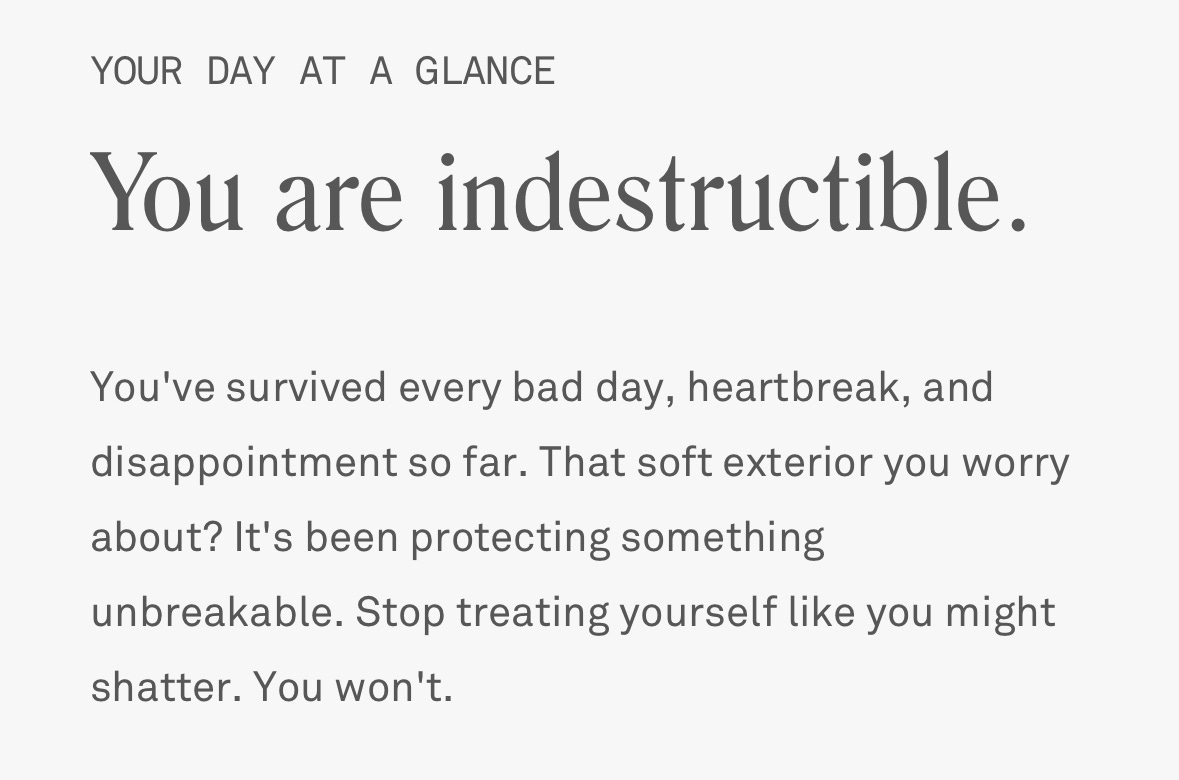
As you’ll see later on, the advice can be more specific in the app, but I’m not ranking the expanded because I basically never open this app—and since the only thing I read is the initial notification, I will only be grading those.
HERE IT COMES
"It’s not enough to just write advice: you also have to make sure that your piece will attract the kind of person who needs to hear the advice and not attract the kind of person who doesn’t need to hear the advice."
This cracked me up for several minutes. Now I'm re-reading it and laughing again.
The book that Jane Austen should have written: Sensitivity and Specificity.