
I can't stop thinking about Obsession (2025)

WARNING: The first two sections of this review are spoiler-free. The rest are incredibly spoiler-heavy, and I’ll place a big wall of text demarcating the start of the spoiler section.
I.
I hate horror. I’ve never even finished a horror game, which you play from the comfort of your own home. You can imagine how well I handle horror movies. (I don’t.)
I also hate corruption arcs. I can’t stand watching relatable characters get worse and eventually suffer the well-deserved consequences of their horrible decisions. I especially can’t stand it when the consequences are relational in nature; I DNF’d Breaking Bad halfway through Season 3, I didn’t even make it past Season 1 of Mr. Robot, and I had to quit Uncut Gems 40 minutes into watching the movie.1
But it was my birthday a while back and I was looking for something to do and it had been too long since I’d gone to the movies. So I asked my dear friend Nora to watch Masters of the Universe with me, she countered with Obsession, and I decided to give horror one more shot.
I mean, come on. The reviews for the movie are excellent. And Obsession about people, not monsters or spirits or scary slasher killers or any of those other stupid tropes that pervade the horror genre. I’ve been on both sides of codependency—it sucks—and I was excited to see a story that would explore it. Better yet, I was suffering from extreme jet lag at the time, and I figured the movie would keep me awake.
Seriously: how bad could it be?
II.
It was horrible.
Let me be clear. Obsession (2025) is fantastic. The script is incredible, the acting is somehow even better, and the whole project is effused with an ineffable sense of purpose that deeply rewards the audience for paying attention. Every act in this movie is intentional; every line of dialogue and every object and even every tiny little facial tics of the characters means something. I cannot glaze this movie enough, and I will do so even more in the following sections that contain spoilers.
But this movie is also MERCILESS. After the very first scene, a cute vignette of our protagonist Bear’s attempt to practice asking out his crush Nikki (to the chagrin of his bestie Ian), the movie kicks into high gear and does not let you take a single breath until it’s all over. I almost DNF’d this movie from the stress; I spent the entire first half doing breathing exercises while curled up into a ball, and the only reason I finished the movie is because I eventually dug my noise-cancelling headphones out of my bag and started playing lofi hip-hop to cancel out the terrifically threatening music and sound design. Oh, and I looked up the plot on Wikipedia so I could mentally prepare myself for what was to come and avoid being jumpscared by major twists. Nora, who is a big horror movie lover, commented that I had “bitch mental,” and I unfortunately must concur. This was a sucky way to watch a movie, but I really wanted to finish this movie—which was NOT going to happen unless I stuck a metaphorical pacifier in my mouth, so I did.
Honestly, it was a relief when the horror-movie schlock (/pos) came out. The extreme violence in the second half of the movie shook me out of my extreme empathy for the characters and reminded my subconscious that this is just a movie and we can stop relating to the characters as if they were real, god dammit. Gore, violence, screaming and crying—that’s all stuff I can handle easy peasy.
But everything else in the movie is downright traumatic. All of our four leads—our protagonist Bear, our charming co-lead Nikki, our slightly sleazy bestie Ian, and the charming friend-next-door Sarah—are so incredibly human, and it’s their very humanness that makes Obsession so hard to watch. I couldn’t help but root for them to make better choices, and so many times they were so close. But alas: this ain’t that kind of movie, bruv. If you have any experience with codependency,2 whether in your own relationships or that of others, this movie will make you sick to your stomach.
Enough. I can’t talk about this movie spoiler-free for any longer. If you’re considering watching it, DO NOT READ THE REST OF THIS REVIEW UNTIL YOU DO.
…
…
…
…
Ahoy, there be spoilers ahead!
…
…
…
…
Still reading? Good. Here we go.
III.
Content warning: rape, self-harm, extreme violence.
The basic premise of the movie is pretty simple. Our protagonist, Bear, is too cowardly to confess his feelings to his crush, Nikki, even after being explicitly confronted by her about his potential feelings (which he denies), and in a fit of frustrated self-loathing uses a magical McGuffin called the One Wish Willow—which sort of functions as a one-time use Monkey’s Paw—to make Nikki fall in love with him.
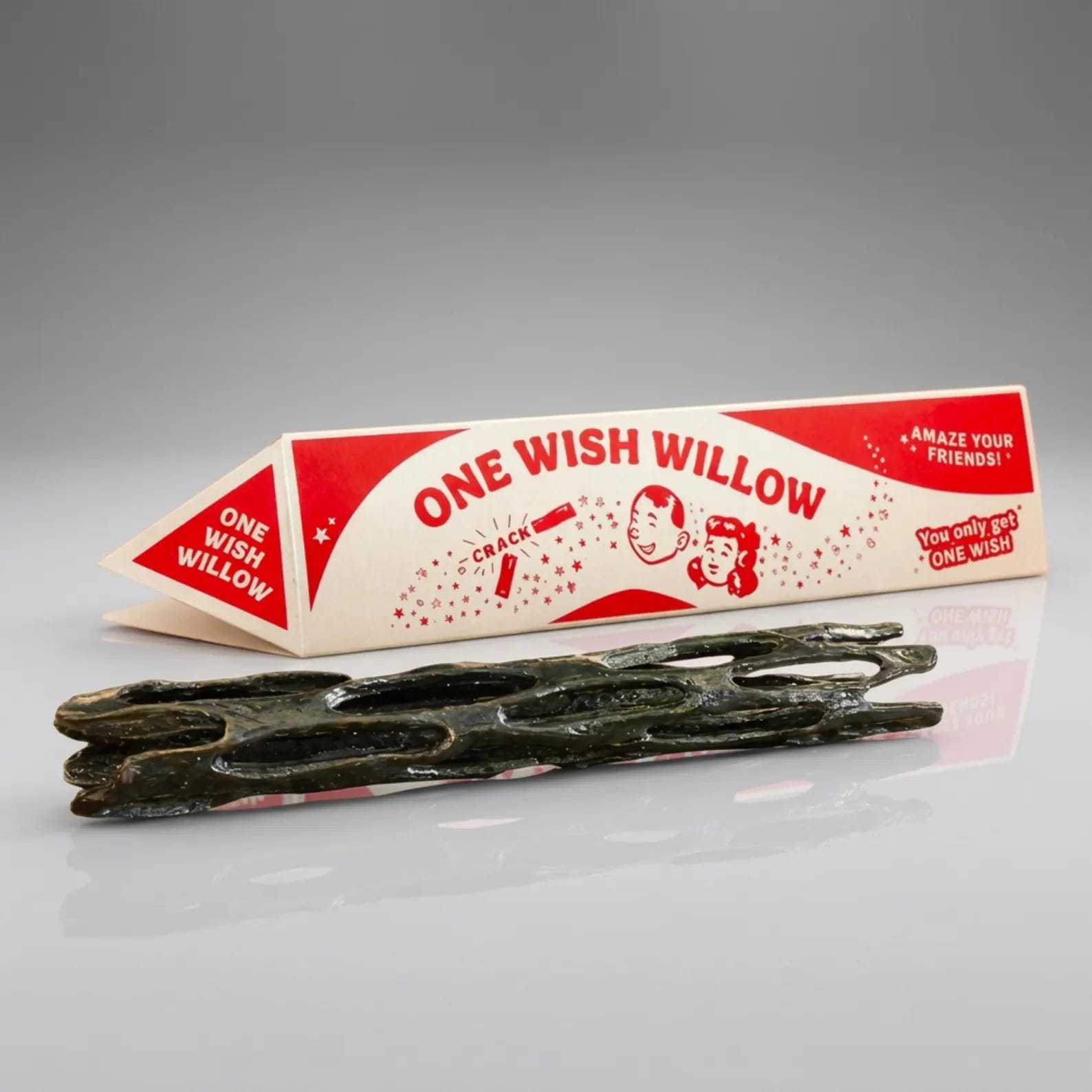
The literal wording of his wish is pretty crazy—“I wish Nikki Freeman loved me more than anyone in the fucking world,” jeez—but the line is elevated by the inimitable Michael Johnston, who delivers the words as a sulky self-loathing tantrum. If Bear had said the words seriously and with ill intent, I would’ve immediately hated him forever. But Bear very clearly didn’t really mean for his stupid outburst to cause any serious harm, and so the consequences of the story are more or less an unhappy accident. Right?
Well, here’s the catch. Unlike the Monkey’s Paw, the One Wish Willow isn’t a malevolent genie, and doesn’t necessarily twist your words into the worst possible outcome. Take this Word of God from an interview with director Curry Barker:
In a twist on the classic Monkey’s Paw scenario, Barker says the One Wish Willow doesn’t necessarily produce cursed outcomes. It all depends on the wish that’s made. “Everyone thinks the One Wish Willow is cursed, but it’s not. Like if you worded it very, very carefully and wished for something you knew couldn’t possibly be bad for anybody, you’re probably fine,” he says. “But if you’re forcing someone to feel a certain way about you, it doesn’t really matter how you word it.”
So just like all the best what-if stories, the central conceit is really about people: in this case, the inner darkness in the heart of man. The Willow is just a metaphor to serve the story. It’s like the old Slavoj Zizek bit; we don’t really want what we think we desire. And after the wish, Nikki—a kinda bro-y slightly bitchy3 girl who hides a heart of gold under her quick-witted exterior—changes beyond belief. She loses all of her uniqueness and depth in exchange for a single character trait: being obsessed with Bear. “Nikki” is simply not herself anymore, and her horror-movie tendencies really start to freak Bear out (come on dude, you CANNOT stand in the pitch-black corner and watch people while they sleep.)
But Bear comes to realize what’s happened pretty quickly—and in a terrifying turning point, decides that he doesn’t really care. Here’s Barker again:
“The moment you’re supposed to realize Bear 100% knows what’s going on is at the restaurant when he asks her point blank, ‘You love me more than anyone in the world?’, which was the exact wording of his wish,” Barker says, referencing a scene that takes place not long after Nikki’s abrupt change of heart. “Then when Nikki says, ‘Why does it matter?’ He says, ‘It doesn’t matter to me.’ And it’s confirmed.”
In fact, this recurring pattern is the real conceit of the movie. Bear is too cowardly to shoot for what he really wants, which is presumably just love; he ends up with what he wants, but in a fucked-up way that harms Nikki’s agency and personhood; he knows it’s wrong, but doesn’t have the moral strength or conviction to fix what he’s broken, because he doesn’t really want it to end; and so it all goes to shit.
Understanding this pattern fixed every plot hole I thought of while watching the movie.
Why didn’t Bear check “Nikki” into a hospital to see what the hell was wrong with her after she had a mental breakdown at his place? Because she was all over him, and he didn’t want it to end.
Why didn’t Bear tell anyone about the nightmarish things “Nikki” did (like feeding him a sandwich made out of his dead cat for some reason)? Because it would’ve meant ruining what they had, and he didn’t want it to end.
Why didn’t Bear go back to the shop to undo his wish once he realized that he had replaced Nikki with some supernatural horror? Because he was finally in a “relationship” with “Nikki.” “Nikki” was nice to him, she loved him, she told him that she needed him and that she loved him more than anyone else in the world, and he just didn’t care that it was fake. He didn’t want to fix it.
Finally why did the wish turn Nikki so evil and obsessive in the first place? Didn’t Bear only wish for Nikki to love him? Well, those may have been the words he said—but deep in Bear’s heart, this is what he wanted. The real Nikki didn’t love him, and the only way for her to love him was to become someone else, and Bear was fine with that possibility. He didn’t want to fix it.
That’s why I started this section with Barker’s comment about the One Wish Willow. The Willow is not an evil genie, it’s just kinda weird, and that means that all the malevolence in the wish came straight from Bear’s heart.
Look, wishing that someone develops feelings for you is fine and normal. I’m sure we’ve all wished for that at some point. But wishing that someone loves you more than anything in the world is sickeningly cruel. The former is an innocent hope for love and connection; the latter is the desire to subjugate, to strip your love interest of interiority. If you wish for the latter, you don’t really care about your lover as a person: you only love their potential to love you. The wish to collapse someone’s entire identity and turn them into nothing more than your lover is EVIL. Bear’s replacing of Nikki with “Nikki” essentially constitutes mind-rape, and Bear’s willingness to have sex with “Nikki” constitutes rape in the standard usage of the word.
It’s a little unclear exactly how conscious the real Nikki is—when she regains consciousness at the end of the movie, she seems pretty surprised at the utter carnage she’s woken up to, which is not what I would expect from someone who was awake and witnessing the events of the movie the entire time—but Inde Navarette does a superb job of making it clear: “Nikki” is not a human and could never be a human. Every malevolent act that “Nikki” commits is somewhat softened by the fact that it isn’t actually Nikki committing the act: it’s just some eldritch horror wearing her body.
But Bear is human. Bear does not have a wish stripping him of agency, nor is he being controlled by some evil entity. Every malevolent act he commits is committed entirely of his own free will, which makes him far eviller than “Nikki,” who is simply carrying out Bear’s own wish. The only thing you can really blame “her” for is cooking Bear’s dead cat.4 Well, okay, I guess you can blame her for killing Sarah too. But Bear had a chance to stop this, and he didn’t. And you can’t blame the Willow, too: this entire thing is all his fault.
IV.
I resisted this interpretation of the movie for the entire first half of its runtime because I wanted Bear to be the good guy.
I know, I know. Stupid optimist walks into a horror movie and can’t help but root for the relatable lead. Sue me. But also, for most of the movie, none of the characters in this world—including Bear—realize that Nikki is being subjugated by a demon. Despite the inevitability of it all, I still found myself hoping that Bear would realize what was happening and finally wake up. Surely he wouldn’t be doing this on purpose, right? Surely he wouldn’t knowingly mind-rape the girl he claims to love?
But Curry Barker somehow knew this about me. And he loved me for it so much that he decided to beat me over the head with my own misplaced hope in Bear. Because right before everything goes south in an irreversible way (Sarah’s murder), Bear reveals his true colors.
Let’s set the scene. At this point, “Nikki” has:
Lied about her dad having cancer so Bear would take pity on her and let her stay the night as his place.
Urinated and defecated on the floor, I think? It was a little hard to tell exactly what was going on, but the point is that she clearly cannot take care of herself.
Fed Bear a sandwich made of his dead cat.
Forced Bear to confess his love for her in some very classic manipulative codependent ways (making a scene in public places, threatening self-harm, etc).
Stabbed herself in the face with a bottle at a party.
Been extremely freaky at nighttime.
Probably more messed up stuff that I can’t remember.
Clearly something is wrong. Bear knows what’s happened because of the restaurant conversation; he knows that Nikki changed because of the wish; and by this point, “Nikki’s” behavior has become so erratic that even people without knowledge of the Willow are beginning to suspect that something is deeply wrong. But Bear still thinks that he’s altered Nikki’s mind; he still hasn’t realized that Nikki has been replaced.
Then—just as Sarah summons Bear to a park, telling him that they need to talk—the real Nikki wakes up, begs Bear not to wake “her,” and then pleads with Bear to kill her. Regardless of whether Nikki has been conscious or not this entire time, the movie makes it pretty clear: she is facing unbearable tortured because Bear’s wish. Bear can’t deny it now, nor can he lie to himself any longer. “Nikki” isn’t the girl he loves. Nikki is suffering. And it’s all his fault.
So what does Bear say? Well, here’s a screenshot from the script.
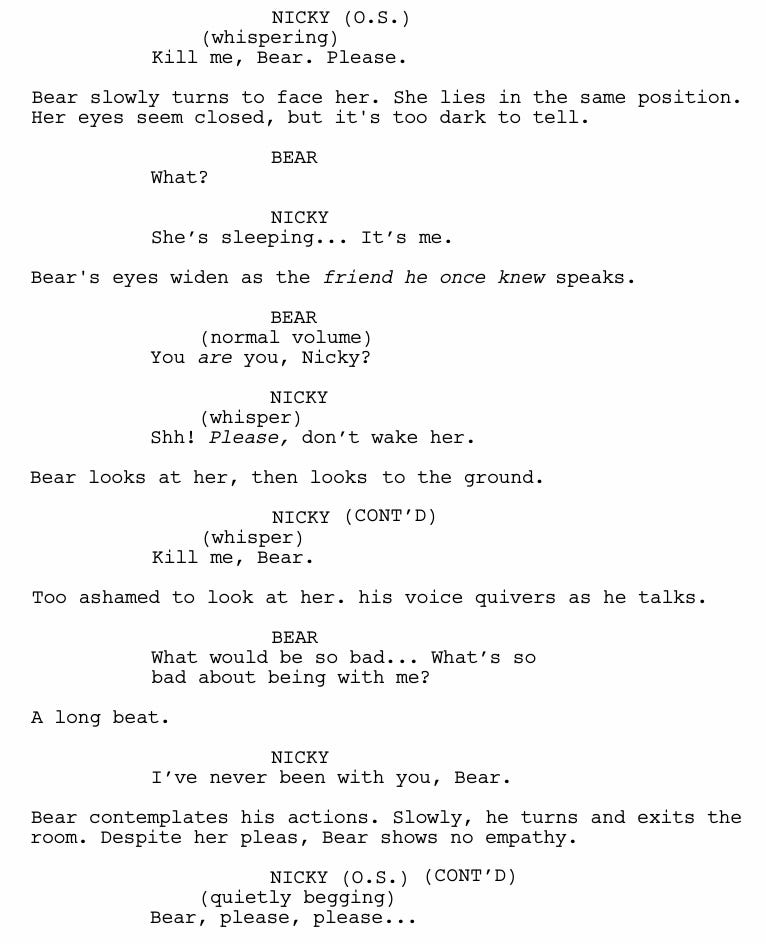
Believe it or not, this scene is actually even worse in the movie. Reading the script, it looks as if Bear is being pathetic: too ashamed to look at her, stuttering etc. But If I remember correctly,5 Bear—who up until now has only been meek and timid and cowardly—suddenly becomes menacing in this scene, for the first and only time in this entire movie. “What’s so bad about being with me?” sounds like a plea, but Bear says it as if it’s a curse, which it of course is. To make matters worse, Barker has Bear step back into a doorframe and in doing so shrouds him in shadow—using cinematic language that, up until this point, has been exclusively reserved for the twisted demon entity possessing Nikki.
In the span of about thirty seconds, Barker broke my heart. “Yes,” he said to me, “You were wrong about Bear. He’s evil, evil on the same level as the supernatural eldritch horror he has summoned to replace his friend. It doesn’t matter whether his initial act was willful or not, because he didn’t try to fix it. He doesn’t want to fix it. He will not be fixed, because he doesn’t want to be fixed. So long as you don’t accept that fundamental truth, you are just like him.”
From that point forward, the only people I was rooting for in the movie were Bear’s friends: Ian, Sarah, and Nikki. But poor Sarah gets murdered by the monster in the middle of her heart-to-heart with Bear, probably because she was building up to a confession of her own (big mistake). And Ian turns out to be an asshole and unintentionally sabotages Bear’s only chance to solve the whole situation by wishing for a billion dollars instead of wishing for Nikki to be freed. To be fair, it’s not like Bear’s story was particularly believable, but come on: if someone came to me with a story like that, I’d listen to them immediately regardless of how little I believed them. I’ve seen enough of these stories by now, dammit. Whatever.
Anyway, in the climax of the movie, Bear finally releases Nikki from the wish by killing himself. Or that’s what I hoped would happen. In reality, Bear can’t even muster up the courage to free Nikki from her own personal hell; he first fails to shoot himself with a revolver and then decides to die via oxycodone poisoning, but can’t go through with it attempts to save himself by vomiting. He only dies because “Nikki” gets her hands on a One Wish Willow and uses it to make Bear fall in love with her, interrupting him mid-retch. I’m not exactly sure what the implications are here—I guess Bear died because of his own wish?—but either way, Barker wants us to know that Bear is a coward down to his very last breath as a free man. And there’s a twisted sense of irony in “Nikki’s” wish. She freed him, after all, and she did so through her desire for him to be obsessed with her—a desire which is only a reflection of Bear’s initial twisted desire to subjugate Nikki.
Finally, the real Nikki survives, emerging at the very end of the movie. If I were to voice one complaint about the movie, it would be that we really don’t get much of anyone else’s POV. I wish I knew what Nikki was going through, and I wish I’d gotten to see some of her feelings or reactions to this whole situation. But of course, this was certainly intentional on Barker’s part. We don’t see Nikki’s interiority because Bear wiped it from existence. The entire movie is shot from behind Bear’s cowardly eyes. And Bear is simply not trying that hard to see through anyone else’s, but he is especially trying not to see what the real Nikki is going through, and so neither do we.
V.
The worst part of this experience is that I couldn’t help but relate to Bear. I said it earlier: I’ve been on both sides of this codependency thing. And while “Nikki” is all the worst aspects of clingy codependency ramped up to 11—why won’t you say you love me, please don’t leave me alone, I can’t believe you’d hang out with other women, I need you more than anything else in the world, I’ll hurt myself if you stop loving me—at least she’s really just a supernatural entity. But Bear is all too human. I saw myself in him when he covered up for “Nikki’s” obviously horrible behavior; I saw myself in him when he insisted that they could make it work, and turned away from the utter horror that he’d caused; I saw myself in him at the very end of the movie, when he still couldn’t go through with ending it all if it would mean not getting to be with “Nikki.”
Most real people don’t live up to the codependent heights of chud loser Bear and his pet eldritch horror lover, but the fundamental dynamics that governed their “relationship” are present in all relationships. People cover up for their partner’s bad behavior all the time. People try to “make things work” with horrible abusers all the time, and some of those people are even abusers themselves. And people refuse to break up with their codependents all the time, even when their relationships are ruining their lives and the lives of everyone else around them—especially when they’re ruining their lives. The darkness is in all of us, whether we like it or not.
And above all else, Obsession is about the darkness in the heart of Bear. Sweet, charming, pathetic Bear, who would never directly harm anyone but would enable literal murder if it meant getting what he wanted. All-too human and fundamentally not evil Bear, who suffered from suddenly attaining the power to get what he wanted without first becoming the kind of person who deserved it. And wretched Nikki, whose life and spirit and very soul are subjugated by the sheer malevolence of the human desire to be the object of someone’s obsession.
Barker says he has an idea for the Obsession sequel, though he doesn’t want to make it for several years. I’m excited to see what he comes up with. I hope Nikki is the main character, but at the very least, I would like to know more about how she experienced the events of this movie (and how they affect her going forward.) But I don’t think I’ll watch it in theaters. My weak heart just can’t take it.
If you’re wondering why I keep giving these movies a shot, blame Simr Sandhu, mister corruption arc himself.
From Wikipedia:
In psychology, codependency is a theory that attempts to explain imbalanced relationships where one person enables another person’s self-destructive behavior, such as addiction, poor mental health, immaturity, irresponsibility, or under-achievement.
There’s obviously more to it, but this is good enough for now.
I really don’t like using this word to describe women, but I think it is too semantically meaningful here to not use. I don’t even mean it in a particularly negative way here—there’s just something about Nikki’s calculated inconsideration that fits the word. Sorry!
I had an interesting conversation with one of my coworkers about this, who thinks that this wasn’t even really malevolent on the part of “Nikki” and that “she” just wanted to do something special for Bear. I’m reminded of the “Chainsaw Man author Tatsuki Fujimoto eats his dead goldfish” story.
and I may not, because I think I had my headphones on at this point (though I could still hear the dialogue), so mea culpa if so
Great analysis. I've been thinking about the movie a lot for similar reasons.
Like it genuinely upset me for a while at how the movie made me sympathize and even partly identify with Bear early in the movie, only to reveal his true nature in the second half. To be clear, I wasn't actually mad at Barker or the movie, I took my reaction as a sign at the movie's quality, but it was nevertheless upsetting to feel so sympathetic to someone who turned out to be a monster. It hits home the ultimate message that normal, sympathetic flaws like social anxiety, neediness, emotional guardedness, and cowardice can turn into something much darker if taken to an extreme.
Something I have been thinking about a bit and don't know what to make of is how to judge pre-Willow Nikki and Ian. While of course, they didn't do anything to deserve their ultimate fates (possession and being shot in cold blood, respectively), they aren't exactly revealed to be perfect people either. It's revealed that they were hooking up in secret despite both knowing that Bear had feelings for Nikki, and it seems like Ian was going out of his way to subtly sabotage Bear's attempts to flirt with or connect with Nikki. Meanwhile, Nikki herself knows all this but still maintained an emotionally intimate relationship with Bear, letting the waters get muddied. To be clear, the hooking up is not the betrayal, it's doing so in secret over a long period of time given the context of their close friendship with Bear that seems shitty.
Of course the rebuttal is that if Bear had been just a bit more assertive, this would have all been revealed to him. It was only his cowardice and guardedness that allowed that dynamic to persist. Perhaps a more assertive Bear would have realized that Sarah had been the better friend to him, and developed attraction for her.
Missed opportunity to title the post: ‘I have an Obsession obsession’