

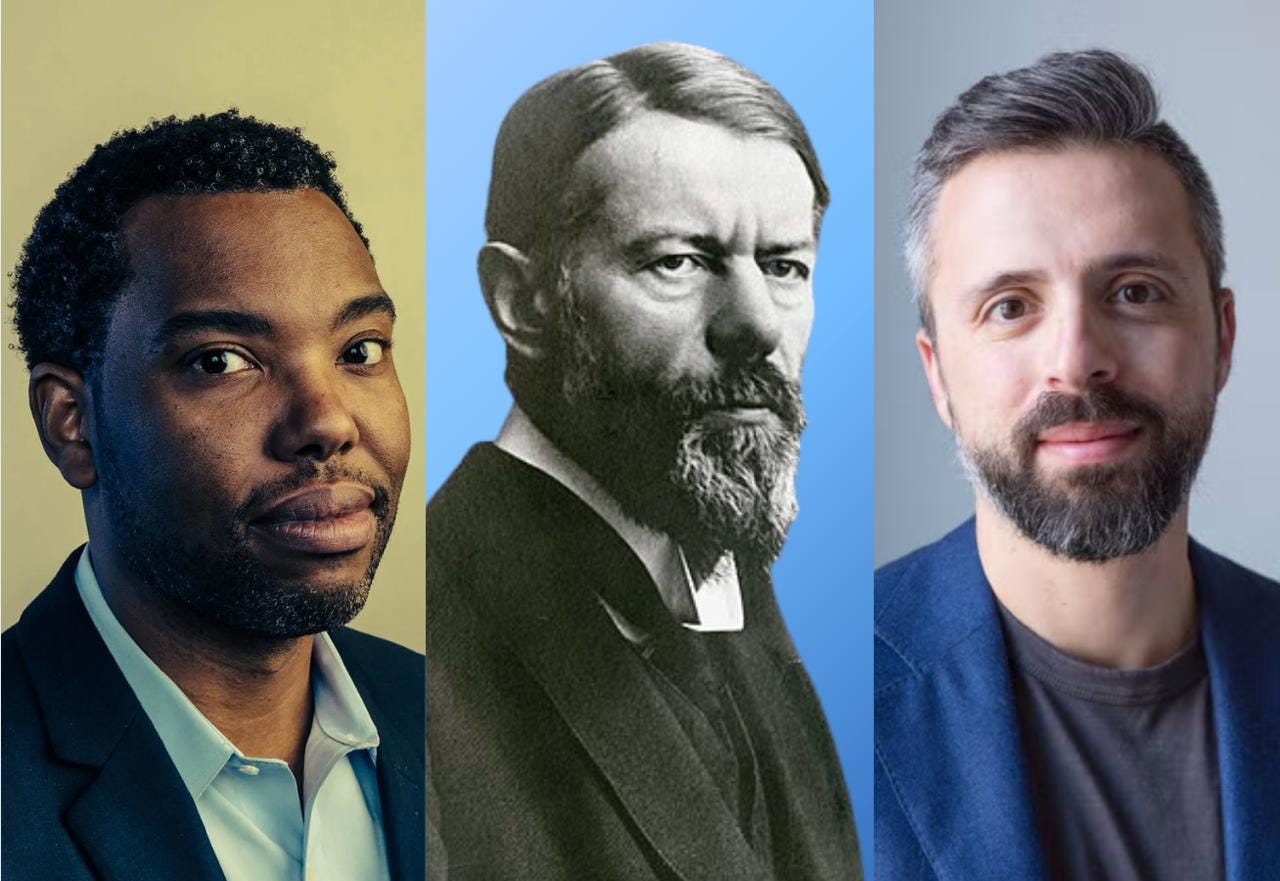
So, I finally finished listening to Ezra Klein and Ta-Nehisi Coates’ conversation about politics post-Charlie Kirk. I also just finished reading Politics as a Vocation by the incomparable Max Weber (thank you to Charles Olney for recommending it to me). While the timing of these two events was completely coincidental, the subject matter of both pieces is remarkably similar. And I think Weber would have a lot to say about Coates and Klein’s discussion—in fact, I think he would be able to resolve the debate they get into.
Of course, Weber is dead. Politics as a Vocation was a speech he gave to German (at the time technically Bavarian) students in 1919. So, I stand here in his place as a flawed and imperfect substitute: the vast majority of this post will be made up of quotations from EK, TNC, and Weber respectively. I hope to do them all justice.
The question at the heart of Klein and Coates’ conversation is very simple: should you say what you must to win, or should you refuse to compromise your moral values?
They don’t phrase it this way, of course, but when Ezra Klein talks about the need to win, the need to connect with people who you disagree with so that you don’t sabotage your own political party and the people you represent, the need to moderate your language in order to win elections, this is what he’s talking about. And when Coates talks about the struggle for history, the generations of Black Americans, who knowingly fought a losing fight because they knew it was the right thing to do, the fact that sometimes people with the best of intentions lose and there’s nothing they can do about it, and the fact that sometimes the best strategy will not deliver victory if the conditions aren’t right, this is what he’s talking about.
Coates knows exactly where he stands. He is not a politician. His concern is not strategy: his concern is speaking the truth. He got some flak on Reddit (shocker) for admitting that his role isn’t to help his party win, but I think he’s absolutely right to say so.
I just want to be clear about something: I shouldn’t be running for president of the United States. You know what I mean? My expectations for the rhetoric of writers, intellectuals, journalists, et cetera, is very, very different than what the expectations should be for people who expect to hold office.
I don’t have a great overarching theory for what everybody needs to do because I think we all have different positions. I know what my role is.
I’ve said many times in the course of this interview: I see myself as a writer. I see myself as a journalist. I see myself as someone for whom it’s very important to state the truth plainly and to clarify things as best I can.
I’m not a strategist for the party, and — as you raised, in that Barack Obama piece — I’ve tried to respect the difference.
Weber also probably thinks that he’s right, given the incredible admiration he holds towards journalists.1
But Klein is really conflicted, and he is conflicted for good reason. He started as a journalist, but he has since become much more.
I don’t know what my role is anymore. I’ll be totally honest with you, man. I feel very conflicted about that question.
The role I want to have is a person curiously exploring his political and intellectual interests in political peacetime. And the role I somehow have is sometimes that. But I’m a political opinion writer and podcaster and so on, and I’m in the business of political persuasion.
And I feel like me and the people who believe what I believe — not narrowly speaking, but the whole broad coalition — have failed in a really consequential way.
Klein isn’t talking about the failure to speak the truth or write a really good and persuasive article. He’s talking about the failure of our politics—and the failure of our politicians. Coates is talking about the ultimate end, the endless push towards the perfect world which we all strive for, but Ezra is talking about responsibility for the now.
I am in a process right now of thinking: We failed. We lost. The loss is having terrible consequences. What do we need to rethink? How do we become competitive again in places where we’re not?
So when he discusses the possibility of running “pro-life” candidates in red states, he’s NOT advocating for getting rid of abortion in those states. What he’s actually advocating for is, basically, lying2.
In 2008, as you and I both know, Barack Obama ran as a public opponent of gay marriage.
He ran opposed to it. At a time when not only — I won’t speak for you — was I not opposed to it, but most of us did not think he was opposed to it. Like, at his heart, we did not think he was opposed to it.
But he was playing politics. That playing of politics allowed him to name Supreme Court justices, and that led to the decision that created a constitutional right to same-sex marriage.
And I am saying that kind of playing politics is needed.
Weber discusses this extensively in his speech.
[A]ll ethically oriented conduct may be guided by one of two fundamentally differing and irreconcilably opposed maxims: conduct can be oriented to an ‘ethic of ultimate ends’ or to an ‘ethic of responsibility.’ This is not to say that an ethic of ultimate ends is identical with irresponsibility, or that an ethic of responsibility is identical with unprincipled opportunism….However, there is an abysmal contrast between conduct that follows the maxim of an ethic of ultimate ends--that is, in religious terms, ‘The Christian does rightly and leaves the results with the Lord’--and conduct that follows the maxim of an ethic of responsibility, in which case one has to give an account of the foreseeable results of one’s action.
and comes down very hard against politicians who profess the ethic of ultimate ends:
You may demonstrate to a convinced syndicalist, believing in an ethic of ultimate ends, that his action will result in increasing the opportunities of reaction, in increasing the oppression of his class, and obstructing its ascent--and you will not make the slightest impression upon him. If an action of good intent leads to bad results, then, in the actor’s eyes, not he but the world, or the stupidity of other men, or God’s will who made them thus, is responsible for the evil.
(This is actually one of his relatively tamer quotes, but for brevity I’ve relegated his other zingers to this footnote.)3
Conversely, Weber is mildly approving of an ethic of responsibility that sounds suspiciously similar to Klein and other “it was our fault!” liberals:
However a man who believes in an ethic of responsibility takes account of precisely the average deficiencies of people; as Fichte has correctly said, he does not even have the right to presuppose their goodness and perfection. He does not feel in a position to burden others with the results of his own actions so far as he was able to foresee them; he will say: these results are ascribed to my action.
(For brevity, I have relegated Weber’s concerns about the ethic of responsibility to this footnote.)4
TNC’s ethic is clearly closer to that of the ultimate ends. He’s a little fatalistic about our ability to guarantee victory at all—sometimes, the “right thing” can’t win yet, hampered by adverse political conditions or simply because it came too early:
We’re losing because there are always moments when we lose.
I am descended from people who, in their lifetime, fought with all their might for the destruction of chattel slavery in this country. And they never saw it. They never saw it. In my personal belief system, they died in defeat, in darkness.
And when I look back at that long tradition, and I look back on the times that people have won and the places they’ve won, it’s often not been their heroism that was the decisive factor, ultimately. It has often not been their strategy that was the decisive factor.
So I guess the privilege that I draw out of this, the honor that I draw out of this, is not that things will necessarily be better in my lifetime, but that I will make the contribution that I am supposed to make.
To be fair to Coates, I’m misrepresenting him a little bit here. It’s not like he’s actually anti-strategy: right after EK talks about Obama running as a public opponent of gay marriage and then turning around to legalize it, TNC talks about how he tried to get Arabs and Palestinians to vote for Kamala Harris:
I can give you an example from the other side, by the way.
[Laughs.] Brother, you know what my position was during the election about Palestine, about Gaza.
Kamala Harris was running to be the first Black woman to be president of the United States. You cannot imagine how animated Black folks were about that. And some would argue the base of the Democratic Party, Black women, were going to see that she was not taking a position that I thought was particularly moral.
I had to talk in front of Black audiences about that, and I had to go before Arab American and Palestinian American audiences here, and say: Look, I’m with you. You can be mad at me. You probably will be mad at me. I get it. But for me, politics is the lesser of two evils. We have been fighting this battle for a long time. We have never had the luxury of electing people who represented the best of us. This is why I’m voting for her. This is a really, really serious thing.
And to be fair to Klein, he’s not exactly a full-throated ethics of responsibility guy either. He clearly has a strong code of conduct, and there are lines that he won’t cross.
Of course, [Charlie Kirk] wasn’t debating to find the truth. He was doing politics. He was trying to persuade people. And I’ve watched on our side, not opportunistic engagement but a lot of, I would say, counterproductive disengagement.
Look, I put up things on YouTube. They’re fairly successful — not the best of the business — and I don’t use “destroys” in capital letters in them.
I think you can do it more aligned to, hopefully, our value structure, our political approach, our political aesthetic. At least the one that I believe in. I shouldn’t overuse the term “our” here. But we weren’t doing that, either.
Ostensibly, Coates and Klein are journalists and not politicians. Coates understands this: he is willing to take some amount of responsibility when he feels the moment calls for it, but his job—his role—is to speak truth to power. Klein, however, is having his doubts. He sees flaws in his party that he is pointing out and no one is fixing. And he cares enough about the ends to consider taking matters into his own hands.
So, for me, it’s not enough to say: We lost, there are backlashes, sometimes you lose. I think it requires a very fundamental rethinking — a disciplined, strategic rethinking — of: What have we been doing? Why are people preferring this to us?
But as Weber points out, politics is evil. Politics is the use of violence, state-sanctioned violence, in order to achieve some ends. And this is fundamentally corrosive to the soul.
Whoever wants to engage in politics at all, and especially in politics as a vocation, has to realize these ethical paradoxes. He must know that he is responsible for what may become of himself under the impact of these paradoxes. I repeat, he lets himself in for the diabolic forces lurking in all violence…He who seeks the salvation of the soul, of his own and of others, should not seek it along the avenue of politics, for the quite different tasks of politics can only be solved by violence.
[I]t is with reference to such situations that Machiavelli in a beautiful passage, if I am not mistaken, of the History of Florence, has one of his heroes praise those citizens who deemed the greatness of their native city higher than the salvation of their souls.
Ezra finds himself in the unenviable position of having an immense amount of power—and an unfortunately admirable sense of responsibility. He clearly doesn’t want this. What he wants is to be the outsider, the journalist who criticizes from afar, the man who can change the world with his words and go home to live a peaceful life. He doesn’t want to be a politician: he wants to be the moderator of political culture. Furthermore, he wants to believe that shaping political culture is good enough to fulfill his sense of responsibility.
I think that I am a person — and I think that you are a person, whether you admit it or not — who is one of the people with a voice in shaping what our political culture is. And I believe at some level that political strategy is downstream from political culture. I think it means exploring things that are uncomfortable and being pretty disciplined, in a way that maybe I haven’t been, about separating the question of what I believe from what I believe will win power. Because I currently think that the cost of losing power is horrifying and dangerous, and we can’t keep doing it. So that’s where my head is.
But despite Ezra’s best efforts, the world isn’t changing fast enough. There are no adults in the room except for those who step up. And even in his language, Ezra has already started to identify with the politicians.
I am saying the thing it sounds like I’m saying. To be very clear. I think in a place like Nebraska, you should try to run some pro-life Democrats. I wish people, instead of saying that an expressive or strategic question in politics was betraying or abandoning the people we wish to protect, I wish what we said was: We lost power in a way that allowed Donald Trump to drive the Supreme Court to a 6-3 Republican majority, and that majority overturned Roe v. Wade and actually abandoned all these people, actually [expletive] them over.
Politics has been his vocation for his entire life, not as a politician but as a journalist. He knows what he wants to do, but he’s afraid, just as any normal person would be. It’s pretty clear that he’s having some kind of mid-life crisis.
I think there are places I’ve failed. I think there are things I got right, too. Like: We shouldn’t have run Joe Biden again. I think I was right about that. I think I’ve gotten a lot right, but I’ve definitely gotten things wrong.
But we are here now, that’s what I would really say. And it is forcing me to rethink things I would prefer not to rethink.
And so, he wavers.
I, like Weber, find this pretty moving
[I]t is immensely moving when a mature man-- no matter whether old or young in years--is aware of a responsibility for the consequences of his conduct and really feels such responsibility with heart and soul. He then acts by following an ethic of responsibility and somewhere he reaches the point where he says: ‘Here I stand; I can do no other.’ That is something genuinely human and moving. And every one of us who is not spiritually dead must realize the possibility of finding himself at some time in that position. In so far as this is true, an ethic of ultimate ends and an ethic of responsibility are not absolute contrasts but rather supplements) which only in unison constitute a genuine man--a man who can have the ‘calling for politics.’
and I hope Ezra figures it out.
Neither Ta-Nehisi Coates nor Ezra Klein are wrong about their fundamental positions, and both of them know it. It is no shame to take TNC’s position and advocate for the truth: in fact, it takes immense skill and courage. And undertaking politics as a vocation exposes you to immense risk, both physical and moral—for no other profession does the Ring of Power sing more sweetly.
Ta-Nehisi Coates (and the Ezra Klein of yore) play vital roles in shaping our political culture. They bring to life history that we forget, insightful analysis that paves the road towards progress, and in doing so shift the Overton window leftwards in subtle but vital ways. Clamoring for TNC to embrace a greater sense of political strategy is equivalent to asking him to change careers: that’s simply not his job. We need journalists whose sole job is to speak the truth and nothing but the truth, for without them we have no window into politics save for the proclamations of Machiavellian liars. We must all engage in politics: we do not all have to be professional politicians.
And yet.
To grossly paraphrase Weber: someone’s gotta do it.
Politics is a strong and slow boring of hard boards. It takes both passion and perspective. Certainly all historical experience confirms the truth --that man would not have attained the possible unless time and again he had reached out for the impossible. But to do that a man must be a leader, and not only a leader but a hero as well, in a very sober sense of the word. And even those who are neither leaders nor heroes must arm themselves with that steadfastness of heart which can brave even the crumbling of all hopes. This is necessary right now, or else men will not be able to attain even that which is possible today. Only he has the calling for politics who is sure that he shall not crumble when the world from his point of view is too stupid or too base for what he wants to offer. Only he who in the face of all this can say ‘In spite of all!’ has the calling for politics.
— Max Weber, Politics as a Vocation
Weber:
The inner demands that are directed precisely at the successful journalist are especially difficult. It is, indeed, no small matter to frequent the salons of the powerful on this earth on a seemingly equal footing and often to be flattered by all because one is feared, yet knowing all the time that having hardly closed the door the host has perhaps to justify before his guests his association with the ‘scavengers from the press.’ Moreover, it is no small matter that one must express oneself promptly and convincingly about this and that, on all conceivable problems of life--whatever the ‘market’ happens to demand--and this without becoming absolutely shallow and above all without losing one’s dignity by baring oneself, a thing which has merciless results. It is not astonishing that there are many journalists who have become human failures and worthless men. Rather, it is astonishing that, despite all this, this very stratum includes such a great number of valuable and quite genuine men, a fact that outsiders would not so easily guess.
Funnily enough, I’m sort of undermining his project here by calling it out. The reason I’m doing so is because I keep seeing people say that Ezra Klein is willing to throw women, trans people, and other minorities under the bus, and citing this kind of rhetoric to prove their point. The following example about gay marriage proves the opposite: Ezra appears to be arguing that an openly pro-gay marriage candidate would not have legalized gay marriage because they would have lost the election—and thus would have been WORSE for gay rights than Obama, who ran as an openly anti-gay marriage candidate.
Whether you buy his argument or not (I’m personally a little skeptical of lying as a strategy—I feel like Obama got away with it because he was the most charismatic mfer to run for office in like a billion years, but whatever), it is both unfair and inaccurate to portray him as genuinely willing to revoke abortion rights or trans rights in order to win elections. All he’s advocating for is being sneaky. And in his worldview, if the choice is between being sneaky and securing people’s rights vs being openly for those rights and losing them, he’d take the former any day of the week.
Weber:
In the world of realities, as a rule, we encounter the ever-renewed experience that the adherent of an ethic of ultimate ends suddenly turns into a chiliastic prophet. Those, for example, who have just preached ‘love against violence’ now call for the use of force for the last violent deed, which would then lead to a state of affairs in which an violence [sic] is annihilated. In the same manner, our officers told the soldiers before every offensive: ‘This will be the last one; this one will bring victory and therewith peace.’ The proponent of an ethic of absolute ends cannot stand up under the ethical irrationality of the world. He is a cosmic-ethical ‘rationalist.’ Those of you who know Dostoievski will remember the scene of the ‘Grand Inquisitor,’ where the problem is poignantly unfolded. If one makes any concessions at all to the principle that the end justifies the means, it is not possible to bring an ethic of ultimate ends and an ethic of responsibility under one roof or to decree ethically which end should justify which means.
If in these times, which, in your opinion, are not times of ‘sterile’ excitation--excitation is not, after all, genuine passion--if now suddenly the Weltanschauungs politicians crop up en masse and pass the watchword, ‘The world is stupid and base, not I,’ ‘The responsibility for the consequences does not fall upon me but upon the others whom I serve and whose stupidity or baseness I shall eradicate,’ then I declare frankly that I would first inquire into the degree of inner poise backing this ethic of ultimate ends. I am under the impression that in nine out of ten cases I deal with windbags who do not fully realize what they take upon themselves but who intoxicate themselves with romantic sensations. From a human point of view this is not very interesting to me, nor does it move me profoundly.
Scathing!
Weber:
Everything that is striven for through political action operating with violent means and following an ethic of responsibility endangers the ‘salvation of the soul.’ If, however, one chases after the ultimate good in a war of beliefs, following a pure ethic of absolute ends, then the goals may be damaged and discredited for generations, because responsibility for consequences is lacking, and two diabolic forces which enter the play remain unknown to the actor.
Surely, politics is made with the head, but it is certainly not made with the head alone. In this the proponents of an ethic of ultimate ends are right. One cannot prescribe to anyone whether he should follow an ethic of absolute ends or an ethic of responsibility, or when the one and when the other.
I will (edit: I wrote this up here https://topkomment.substack.com/p/politics-as-a-vocation-and-the-democracy) comment more extensively later, but I do have one quick addendum to the 'what does it mean to say we should run pro-life candidates' part of the conversation. That is: I think there's a big difference between saying 'we Democratic elites should actively seek out pro-life Dems because we should stop treating reproductive rights as core party branding' (which is terrible advice for both ultimate ends AND responsibility reasons) and saying 'we should as a party think about which of our values we literally cannot compromise under any condition and which ones we can tolerate heterodoxy, and also should think about whether tolerating heterodoxy in X, Y, or Z specific area might help us win more elections and in the process achieve more of our core values.' And I think a lot of people hear the former when people are trying (perhaps badly) to say the latter.
Also, to be clear: this second idea may or may not be good strategy. I just think it's pretty hard to argue that it's conceptually flawed. I also don't think it's really 'lying' in a traditional sense. Obviously, when its located in a single person (Obama and gay marriage) it amounts to a lie. But the broader tactic isn't really for people to purport to be anti-gay or pro-life or whatever, but just for 'the party' as a conglomeration of millions of people to say 'even though we care a great deal about X, you're still welcome if you believe not-X" where X isn't even really just 'abortion' or 'gay rights' or 'being critical of Israel' or whatever, but instead is just a floating signifier for [stuff that progressives consider to be non-negotiable].
Not to 'assign' more reading, but I've always felt that Politics as Vocation and Saul Alinsky's Rules for Radicals were sort of companion pieces, and I think Alinsky would treat 'should we encourage people to vote for us even though they disagree with us on some important stuff' to be a ridiculous question. Because of course we should! For one thing, winning is important. But also because voting and candidates and elections are necessary evils, not locations for self-actualization. So stop being so precious about them.
Assuming I do write something more, I'll be sure to elaborate on all that :)
I think part of the issue is that they're all seeing the left position as a fixed agenda, as if we really are certain of our goals already. The reason to be more open to other views and to opponents (imo) isn't to cynically manipulate people and win, it's that we genuinely shouldn't be so set in our thinking or unwilling to compromise. It's good to keep dissenting voices around because they bring other perspectives and allow you to more effectively rethink and pivot when needed. It's good to be genuinely undogmatic.
An idea I like from Roger Scruton and Lord Sumption is the idea of democracy/politics as not being essentially about representation, but about facilitating compromise and maintaining social homeostasis. For Scruton this is the essential conservative view of politics, whereas the progressive view is essentially about imposing one's grand agenda. (To be clear, I don't think this maps onto MAGA conservativism)