
Two Big Nerds' Guide to Small Talk
Because normal people are worth knowing


Growing up, Charlie & Harjas were what you might refer to as big nerds. Besides having outsized interest in a lot of academic and intellectual topics, they also lacked a certain amount of social instinct. These factors combined led to a conviction that the stuff normal people talk about is boring. Why would Charlie want to discuss the weather when he could infodump about what D&D classes the Founding Fathers would be?1 Young Harjas felt similarly. Sure, it was fun to talk about people sometimes, but it was more fun to talk about space, or history, or the history of space, or utilitarianism vs deontology, or the entire history of the Halo universe and how the 343 Industries takeover led to the slow and steady death of the beloved franchise.
Shockingly, this approach did not win any popularity contests. It’s a good way to find other nerds, but unless you move to San Francisco, it’s unlikely that you’ll live in a nerd enclave, and like half of those nerds are evil nerds at this point so you probably don't want to hang with them anyways. And in college, which arguably should’ve been the biggest nerd enclave of all, Charlie realized that a lot of his classmates were normal and wanted to talk about boring stuff. They enjoyed it. Meanwhile,2 high school Harjas realized that his social ineptitude was preventing him from really getting to know many people who he liked and respected. If I like people, he thought, why am I so opposed to trying things their way?
Both of these reformed small-talk-haters had the same realization: It’s good to befriend and spend time with the normal people in the world. If you cannot connect through boring topics, you’ll never get a chance to connect through things that are more interesting to your nerdy little sensibilities.
You may, in fact, discover that you have more in common than you expect.
What is Small Talk for?
Before you can have a connection with a person, you need a foundation of trust. Small talk exists as a sort of vibe-check handshake. Your interlocutor is always making small, implicit assessments of your character. They start with, “do I believe this person is not insane?” and build up to things like “do I think this person really listens to me?” and, “do I and this person have compatible worldviews?” You are likely making the same assessments, and if you’re not, you should be. Small talk is how you both check the “not insane” box for one another.
All the typical small talk topics—the weather, traffic, where people are from—are intentionally surface-level, universally relatable and unlikely to create a strong reaction. The goal is to converse in a way that gives the other person ample opportunity to agree, to feel noticed, to offer up other topics. They need to do all this without feeling exposed, vulnerable, or like they will risk offending you. What you say is less important than how you say it. Establishing this mutual trust and respect gives you and the other conversationalist an opportunity to talk “bigger.”
If you’re anything like Harjas (aka neurodivergent lol), you probably agree with the above on some level, but have no idea what this actually looks like and want some taxonomy of statements to be able to think about. If so, good news: we have a handout for you!
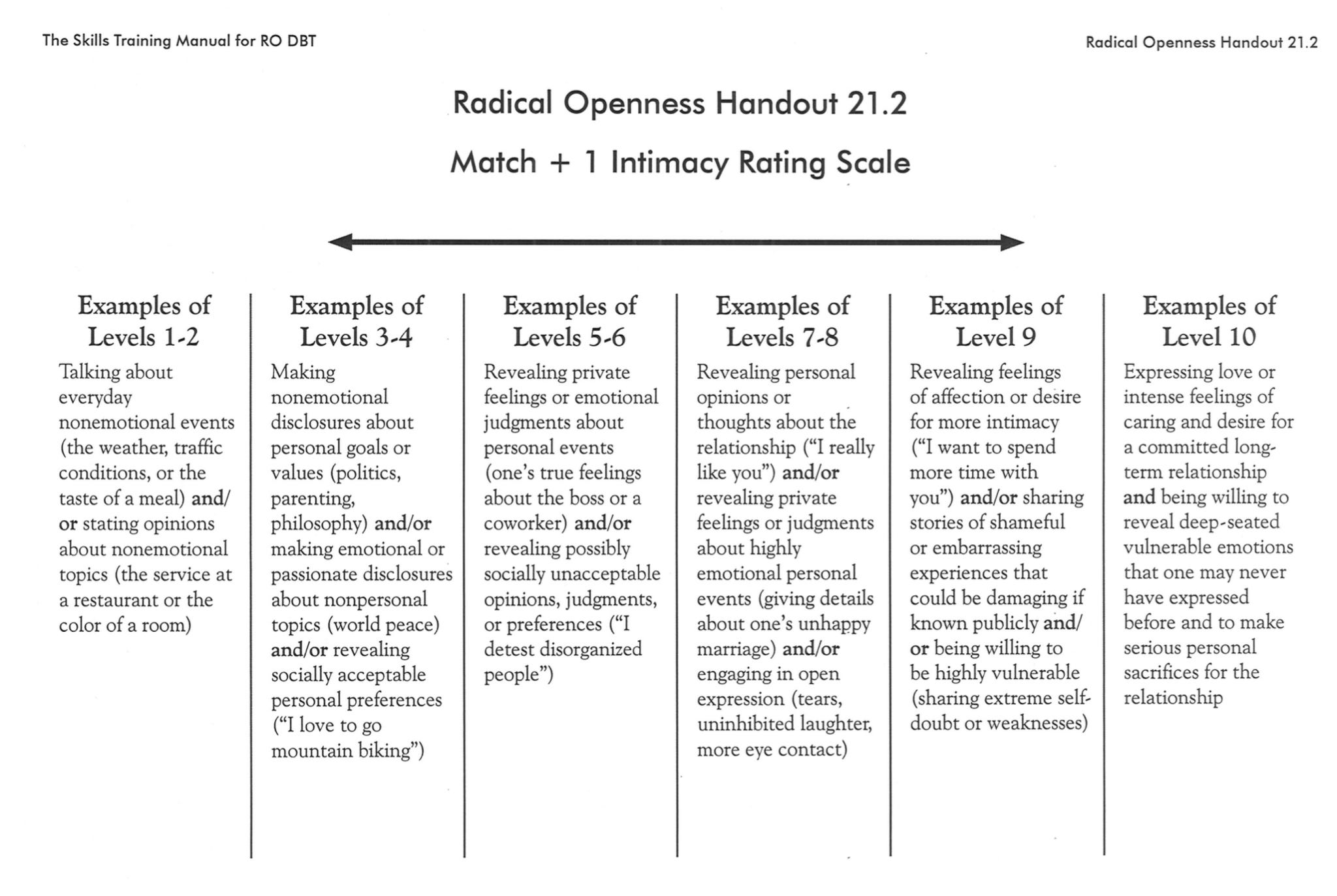
This is the Match + 1 Intimacy Rating Scale. The scale exists to provide a rough ranking of statements by vulnerability, and in doing so provide you with what amounts to a conversational flowchart. In practice, this might look like:
Enter a conversation.
Figure out how much I trust the other person / what level we are operating on. For me, strangers start out at levels 1-2, reach acquaintance level around 5-6, and become true friends at any level beyond. (Also note that lower levels are not necessarily “better”—you don’t have to always be talking about “deep” stuff. The purpose of this chart is to help you think about what you can talk about with people, not what you should.)
Spend some time at that conversation level.
Determine how I feel.
If the conversation is going well and I’m getting good vibes, go 1-2 levels deeper.
If the conversation is going poorly and the other person is being weird / evil, go 1-2 levels shallower.
If the conversation is going acceptably and I’m happy with where we are, don’t change anything.
(You can read about this system in more depth here).
For people that you see regularly, repeated small talk works as the foundation for a pleasant acquaintance-ship, whether or not you’re building towards a deeper friendship. Although asking your neighbor about their garden may not feel very exciting, repeated small interactions build trust and presence in a relationship. Over time, these small interactions make the relationship comfortable, effortless. As Simon Sarris says in Familiarity & Belonging,
Familiarity is crucially the maintaining of weak ties, or else the maintaining of strong ties in weak ways. Some things can only be made strong by binding one thousand tiny threads.
Whether you’re trying to build a relationship that is strong and familiar or increase the depth of conversation with an existing acquaintance, small talk and the Match + 1 scale can help you get there. The tactics of good small talk are straightforward, but like any other skill, benefit from awareness and practice.
How to Make Effective Small Talk
Pick small topics
Small talk can have two goals: build the foundation for a deeper level of conversation and closer relationship, or maintain casual connection with acquaintances. Both are valuable! No matter who you’re talking to, it’s worth noticing the intimacy level of your conversation, and checking in with yourself whether you want it higher. It’s ok for some folks to just be acquaintances and not really go above 4-6! If you would like to escalate, use the +1 method.
We already touched on a couple common small talk topics: traffic, weather, places, big media events (sports, award shows, etc.). These topics are unlikely to offend or alienate a person, and they are based on an experience that you’re very likely to share. Everyone can agree: man it’s hot. Damn traffic sucks. Isn’t this part of town cool?
Be present in your environment and engage with the physical place you inhabit. You don’t need a full-blown mindfulness practice to know that traffic was really bad today, but if you don’t touch grass enough, you might not know that one of the city’s parks is closed for the year while they make renovations. If you’re struggling for something to say, an easy format is noticing an experience you are having (or had, recently) and simply asking somebody whether they also had that experience. (“Man, have you seen the traffic on 51st street??”)
It can be tempting in these instances to whip out a hot take. “Actually, I didn’t watch the Masters, because golf is a massive waste of resources and every single golf course should be turned to pasture.” For a first meeting, this is pretty aggro! It’s a 5-6 on the Intimacy scale, whereas the question of “did you watch x media event” is more like a 1-2. Once you’ve built some rapport, however, that type of escalation is exactly the way to build closeness. If you really insist on whipping out your hot take, you can drop it down to levels 3-4 simply by being less emotionally invested in it. “Oh, I didn’t watch the Masters—I’m actually not a golf person” is much more reasonable.
However, do be careful with negative statements. As Adam Mastroianni put it, good conversations have lots of doorknobs; they consist of taking opportunities to share things about yourself (which he calls being a taker) and inviting the other person to do the same (which he calls being a giver). If we use this framework to analyze the golf statement from earlier, we can immediately see how the golf statement might represent an empty wall. If someone doesn’t yet feel comfortable arguing with you—or simply doesn’t like arguing—they won’t be able to respond to your statement about how golf sucks. There is no way for them to respond save for “well I disagree!” or “um, ACTUALLY…” and both of those options are pretty uninteresting.
Avoid conversational walls
One way to avoid a conversational wall is to simply be more of a giver and add several doorknobs to your negative statement. For example, you could say “Actually, I’m not a huge fan of golf. My father used to make me play when I was younger, which kinda killed my love for the sport, and now I’m a runner.” This sentence now has two doorknobs—the story about my dad making me play golf, and my feelings about running—and your conversation partner now has the choice to pull on either doorknob.
To encourage a monologue, you’ll alternate between indicating your interest and guiding the storyteller. To indicate your interest, you can practice active listening: eye contact, nodding, an occasional “mhm” or “oh,” and reacting in an engaged way.3
To guide a storyteller, ask questions you want to know the answer to! They are giving you threads to pull on, and unless they skip over part of a story or seem uncomfortable explaining some background or context, you should assume they want you to pull the available threads. One very easy way to do this is with the Solid Snake method of conversation, which is literally just parroting back a few words from their sentence to indicate that they should clarify or go deeper on that part.
“Sorry, I’m kind of tired - I just got back from Chattanooga.”
“Chattanooga?”
“Yea, some friends and I went down for Bike Camp.”
“Bike Camp?”
“Yea it’s this weekend of camping and biking and a bunch of cool events…”
There are many non-Solid Snake methods for being a good conversational giver, but it may be the simplest. Overusing this approach can sound just as weird and stilted as the videogame dialogue that inspired it:
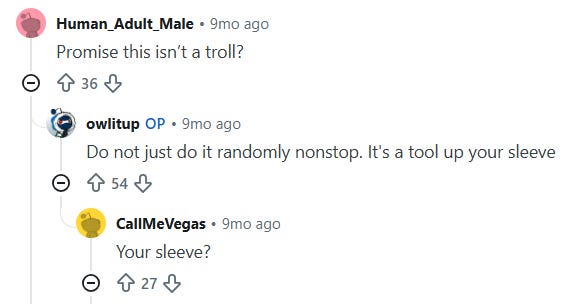
Thoughtful application, though, will not only show the speaker that you’re interested, but tell them exactly where your interest lies. This elicits better storytelling and gives you the information you’re interested in—exactly the win-win good communication should be. You can also just add a question to the end—for example, “Oh Bike Camp? That sounds cool—what is it?”
Remember to take sometimes!
That being said, don’t shy away from being a taker. Telling stories and disclosing things about yourself is a HUGE part of small talk—in some sense, it is the entire point—and if you and your conversation partner are both givers, you may run into a field of shallowness in which both participants ping-pong questions back at each other because neither is willing to monopolize the conversation with a monologue. Neither taking nor giving are inherently wrong: they’re simply bad when they’re not balanced, which usually happens when one (or both) participants aren’t being responsive to the other participant’s desires. The best conversations tend to have varied rhythms, and leave room for both participants to go on monologues encouraged by the other. Refusing to take on the conversational spotlight means pushing it onto your conversation partner, who may or may not appreciate the pressure to keep talking.
The key to good taking is being responsive. Yes, you should be comfortable telling some story or anecdote to completion, but if your conversation partner looks bored, or keeps interjecting, or asks you a question that would require you to divert focus away from your story, you may want to consider following their lead and saving it for another time. Alternatively, if you really value what you’re saying and want them to hear it, you can (mindfully) barrel on with your monologue. If you do this, you may want to keep one or two of their interjections in mind; once you’re done, you can steer the conversation back to those interjections (and by doing so communicate that you were listening). That being said, Harjas tends not to continue stories past 2-3 interjections unless his conversation partner explicitly asks him to (“you were saying?”), which works well with attuned listeners but does not work well for the well-meaning but prone-to-interruption conversation partner. Charlie tends to be a little bit optimistic about his stories’ payoffs and will push through for a while before he realizes he’s losing his listener—a growth area for both of them, to be sure.
We’ll Always Be Learning
Despite producing ~3,000 words on it, your authors are not experts in small talk or relating to people; they are just nerds who have learned the value of these skills. They continue to improve with more practice, more learning, more thoughtful feedback (explicit and implicit) from the people around them. They hope this article will serve as a jumping off point for fellow nerds and other interested parties who wish to go forth and prosper in communities of their own.
Anyways. Crazy weather we’re having, right?
Appendix: Small Talk Example
Here’s an example of successful small talk at the early levels:
Person A: Boy, it’s hot today! [said warmly, opening at levels 1-2]
Person B: It sure is! I love warm weather! [moving from 2-3]
A: Niceee. What do you like about it? [giving]
B: Oh, I grew up in a warm environment [doorknob]. Winters here are pretty, but I get pretty gloomy when it’s cold and dark out [doorknob]. I can’t wait for beach weather. [doorknob]
A: Oh yeah? Where’d you grow up? [giving, chose doorknob 1]
B: [talks about their life story for a bit, taking]
A: That’s great. I grew up in San Francisco, so I’m really not used to this warmth—it’s honestly a little too much for me [doorknob]. Actually, I’m kinda heat-sensitive, because the sun seems to trigger my Rosacea [doorknob].
B: San Francisco, huh? How’d you end up in Chicago? [recognizing that A wants to talk about themself, pivots from taking to giving, chose doorknob 1]
A: Well, it’s a long story…
If these people realize that they like each other and are vibing, here’s how they might get to know each other better:
B: Yeah, that’s crazy! How do you feel about the move? [giving opportunity for A to answer at whatever level they want]
A: Honestly, I’m conflicted. I mean, I love Chicago, but I really miss home. It’s funny in hindsight—I couldn’t wait to get out of my parents’ house, but now I kinda wish I was back there. What about you? [A moved down to levels 5-6 and left a few doorknobs, but realized they didn’t want to talk about it in more detail yet, so they asked a question to move the spotlight away from them]
B: Man, I feel ya. I actually grew up here, so my parents are still in town, but I feel like I don’t visit them enough. It just seems like I have so much time. But they’re not getting any younger, you know? [B graciously takes the spotlight and also moves down to levels 5-6 while keeping the conversation topic roughly the same]
A: Mhm. How old are your parents? [still shifting spotlight away from them]
B: Oh, in their 60s. You wouldn’t know it by looking at them though—they’ve aged well. But I worry about what life will be like without them. I read this thing a while back about how people spend 90% of their time with their parents by the time they’re 18, and it kinda freaked me out. [keeping spotlight, still disclosing serious stuff, but is now getting personal themselves]
A: Ugh, I definitely didn’t appreciate the time I had with mine. My dad passed away a few years ago and it completely wrecked me. I wish I’d gotten to know him better. Now I try to call my mom once a week, but it still doesn’t seem like enough. [A has come to really like B and is now moving to levels 7-8]
B: I’m so sorry to hear that. If you don’t mind me asking, what happened? [B senses that A wants to talk about it and shifts the spotlight back to them]
Etc etc…
Thank you so much to Charlie T for being my co-writer on this post—it was a blast. If you liked this post, go check him out! (and of course, consider subscribing to me too if you haven’t.)
Further Reading


Charlie says: “Jefferson is a bard, Franklin is an artificer, Washington is a paladin, Patrick Henry is a warlock, Sam Adams is a barbarian, George Wythe (deep virginia cut) is a Wizard. hmu if you want me to run this game for you”
in quite possibly the same year, since Charlie is an Old Zoomer and Harjas is just a zoomer
Quick aside: in college, Charlie’s friend accused him of nodding too much during lectures. But when a classmate presented, they sent him this very nice note afterward:
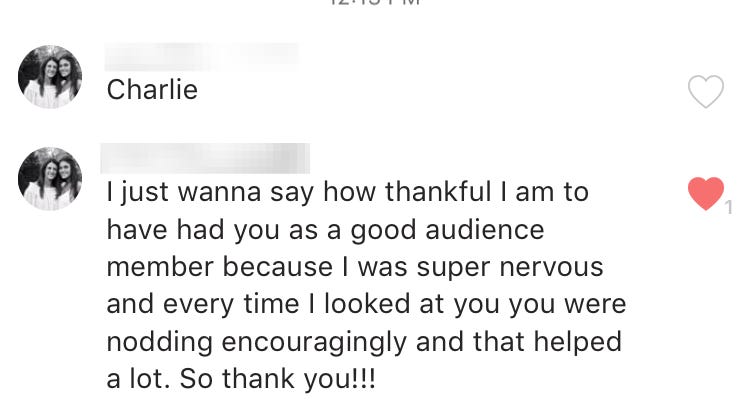
One lesson from that experience: these signals are helpful to send, but they have to be genuine! You don’t want to hit somebody with a “damn that’s crazy.” Insincere signaling does you both a disservice, because a decent conversationalist wants to tell you an interesting story. Denying them a usable signal means denying them the opportunity to switch tack if they’ve wandered into a topic that doesn’t interest you.
(Note: Harjas would argue that the phrase itself is fine—it’s more about the context. If you say “damn that’s crazy” once, you’re probably fine: more than twice in a row, that’s on you. Charlie would argue that at this point the phrase itself is tainted and should be retired.)
 | A guest post by
|
I do honestly think the basic point about smalltalk is that you typically don't really need it with people who you can easily get to 9-10 with. Sometimes there is a natural chemistry and you can just keep escalating and it works great and someone is telling you about their relationship with their in-laws even though this is really your first 1:1 conversation and now you have plans to go to a play next month.
And other times, you can progress to talking about how they like raising kids in the city at a surface level and realize that's probably as deep as your relationship can ever be.
I think the main thing that I realized about smalltalk, is that even though I value the first kind of relationship 100x more than the second kind, you actually still need to have some of the second kind. Like you're not gonna become best friends with every single coworker or every single friend of friend or every single receptionist at your pediatrician's office. But it's still better to have pleasant interactions than unpleasant ones.
I have spent a lifetime struggling with NOT jumping to level 8 directly after getting a positive signal from level 2. I have observed that it comes naturally to a lot of people, the effortless glide across the various stages. If it is not innate, then it is a constant and draining struggle to keep calibrating in real time. In a big party, where you are expected to conduct several of these implicit negotiations, it can be exhausting. Can this skill be learned? I think so. I have got better at it with age and also after I stopped caring. Hope this helps a lot of people, there should be live classes for this where people can try it out with flash cards with numbers on them “Hey can we please move to stage 4 :). “