
100 posts in one year: what I learned
everything I know about blogging

One year ago, I wrote my first post: About Hardly Working. With the benefit of hindsight, my first written words on the blog are pretty interesting.
I wrote:
Hello! I’m Harjas, a Physics major at UChicago. I’ve been an armchair analyst for as long as I remember, and have wanted to start some sort of publication for about as long—so here it is!
I’ll be figuring out more of the specifics as I go
Well, one year later:
I’m still very much an armchair analyst.
I’ve written over 100 blog posts.
I still don’t know what the blog is about.
In my opinion, the best description of blogging comes from How to Substack by Max Read. He says:
What most successful Substacks offer to subscribers is less a series of discrete and self-supporting pieces of writing--or, for that matter, a specific and tightly delimited subject or concept--and more a particular attitude or perspective, a set of passions and interests, and even an ongoing process of “thinking through,” to which subscribers are invited.
I’ll hopefully have more to say on this point soon, but for now: the vagueness is what makes a blog, well, a blog. Hardly Working isn’t a “publication,” nor is it any other multisyllabic word used by wordsmiths to make themselves feel cool about posting their thoughts online. It’s a dinky little newsletter storage website. That’s what I do here: I write posts and send them to people as emails and keep the emails on the blog. And more than anything else, my blog is about “thinking through,” and doing so in public.
If this description appeals to you, and you want to try blogging yourself, I have great news for you: the rest of this post is my advice on how to do that. It’s not exactly directed at success though—it’s more just, important things that I learned on this journey.
If you’re looking for advice on how to get big or leverage blogging to do great things, you can find some of it in this post, but you may be better off reading some of the resources I’m going to be linking to.
If you are looking for how to be a blogger, this post is for you.
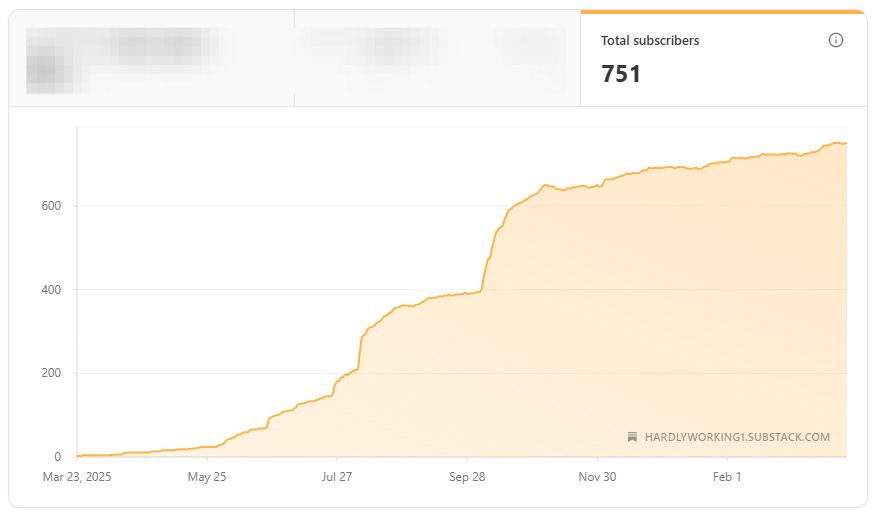
Before we get started; it’s far too easy for me to get lost in the sauce of big numbers online, so I just want to acknowledge the fact that 750 of you sign up to read my emails. That’s insane. I am humbled by your support.
Thank you all so much for being here, and here’s to another great year!
Linkpost section
Here is all the actual blogging-specific advice that I am glad to have read and think you should consider reading. I ordered these links in a way that makes sense to me, but you can also just read the ones that stick out to you. This is not a sequence.
Also, many of these pieces are highly opinionated and give conflicting advice. This is intentional. Blogging means something slightly different to everyone who blogs, and it will mean something different to you too.
Why You Should Start a Blog Right Now by Alexey Guzey. A simple and motivational guide to blogging.
Why and how to write things on the Internet by Ben Kuhn. Probably the most actionable guide out this list: Ben talks at length about the benefits of blogging and also gives a lot of good blogging advice.
How to Substack by Max Read. The best explanation of what it means to be a Substacker + some practical tips.
Matt Yglesias and the secret of blogging by Max Read. A profile on Matt Yglesias and a case for quantity over quality. Also check out Matt’s interestingly humble comment on the article.
How to write a successful Substack by Noah Smith. Straightforward Substack-specific advice from a titan in the space. If you’ve always wondered what the big fish think about their own writing processes, this is a great place to start.
My advice on (internet) writing, for what it’s worth by dynomight. Clear and important high-level advice from one of my faves. TDLR; make something you would actually like. What does that mean? Read the article!
So you’re thinking about writing on the internet by dynomight. Observations about the dynamics of writing on the internet from a guy who’s been at it for a long time.
Where have all the good bloggers gone? by Sol Hando. Scott Alexander’s blogging advice + some helpful comments from Sol, who is a great blogger himself.
Every marketing channel sucks right now by Andrew Chen. Growth marketing for startups: it’s not explicitly about blogging but really cemented “quality is king” into my head.
The Art and Business of Online Writing by Nicholas Cole. I’m still working through this after Abi Olvera recommended it me, but it’s been very thought-provokingso far. If you hate money and don’t want any attention, don’t read this book: it’s super opinionated and mostly about the business / profit-maxxing side of things. I’m probably gonna do a book review at some point.
Tolstoy and Austen aren’t world-historically unique and special geniuses by Naomi Kanakia. A great piece about the struggle to write for the market while preserving creativity: it left such a strong impression that I wrote about it last June.
An unordered collection of writing-specific advice:
Nonfiction Writing Advice by Scott Alexander. Wasn’t helpful the first time I read it, but somehow it gets better every time I reread. I suspect my takeaways will only continue changing as I get better at writing.
The comments on my Reddit post What makes Scott Alexander’s writing so great? on r/slatestarcodex. Many of these comments are genuinely very insightful, particularly those by ScholarsStage. (My post is just okay.)
Noah Smith’s writing advice by Noah Smith. If you don’t know everything in this post, you should probably (re)read it. Particularly interesting: his post categorization scheme of responses, takes, theses, lessons, roundups, and narratives.
How to write quickly while maintaining epistemic rigor by John Wentsworth. Great post that I’m still trying to internalize. TLDR: stop trying to justify your beliefs. Instead, think about why you currently believe this thing and try to accurately describe what led you to believe it.
Gwern’s 2025 Inkhaven Writing Interview by gwern. Hard to describe: Gwern is a powerhouse and you should read this even if you don’t agree with or implement any of it, which you probably won’t. I know I won’t, but I’m putting it here for a reason.
First, Make Me Care by gwern. “When writing, first, make the reader care, one way or another. Because if I am not hooked by the first screen, I will probably not keep reading—no matter how good the rest of it is!”
Writing advice: Why people like your quick bullshit takes better than your high-effort posts by Georgia Ray. Some of the most useful writing advice I’ve ever read: it came exactly when I needed it, and I reread it every few weeks.
Why people like your doodles better than your finished works by dimespin. The art version of the previous post. I didn’t think I would get anything out of this, having already read the text version, but I was wrong.
A guide to effort-posting by Naomi Kanakia. Reverse the advice in the previous two links, and you get this one. Naomi articulates the difference between a blog post and magazine article in a way I had not consciously understood before.
A Field Guide to Writing Styles by Linch. A fascinating guide to different ways of writing. Few other posts on this list actually deal with the technical mechanics of the craft. Linch does so with, uh, style.
Politics and the English Language by George Orwell. A seminal classic on unclarity and good writing: unfortunately, I cannot tag the guy. I don’t agree with everything he says, but you should absolutely read this piece; he’s far more opinionated than Linch, but come on, it’s Orwell.
Good Writing by Paul Graham. Graham has several excellent posts on writing, so I’m just picking this one because I like it. You can’t go wrong with any of his blog posts.
Vonnegut’s first rule is the only rule of writing that matters by Linda Caroll. A good reminder that came just when I needed it.
CRIBS: My Writing Feedback Formula by David Perell. How to get feedback from non-writers. If you want practical advice on writing, all of David Perell’s stuff is great.
An Explanation of Common Writing Advice by u/Mithalanis on r/writing. This is a great post about five common but underexplained pieces of writing advice: just write, read more, kill your darlings, don’t use adverbs, and write what you know.
An unordered collection of the mental and philosophical side of creation and ambition:
The Inner Ring by CS Lewis. Not really about blogging, but envy and comparison: everyone should read this, ESPECIALLY those who wish to be “popular” or “powerful.” Unfortunately, I cannot tag him either.
The Secret to my Productivity by Hank Green (YouTube). An anti-perfectionism lifesaver that provides an actual guideline for when a work is done. I have had several people tell me that their creative processes actually changed after I linked this video in one of my blog posts. I myself got it from the following video:
TEN YEARS of OSP by Overly Sarcastic Productions (YouTube). One of my favorite pieces on creating: the full story of people who started with nothing and created something amazing. I also just love OSP.
[Bauble] What it Looks Like to Get Good at Writing by E. Harkness-Murphy. A great essay on what it is like to get good at writing. I found it very motivational as a fledgling blogger, since I had no idea that something like this was possible (or at least didn’t know what it would look / feel like).
My Notes from ‘So Good They Can’t Ignore You’ by Cal Newport by Matt Beard. There is a lot of useful advice in this article, but even more useful is the general vibe. Always remember that quality is king.
Do 100 thing by visakan veerasamy. A list of examples of people getting good by doing something a bajillion times. Pairs well with the above.
A blog post is a very long and complex search query to find fascinating people and make them route interesting stuff to your inbox by Henrik Karlsson. An ode to being yourself online. Very opinionated but required reading IMO. Consider this to be the reverse of The Art and Business of Online Writing.
Expanding the Market for Literature (ft. Celine Nguyen) by Jasmine Sun and Celine Nguyen. I particularly the bit starting at 11:00, but there are lovely insights about art and the internet and online culture sprinkled throughout the conversation. (And many of Celine’s posts on writing and blogging and other stuff are in my read later queue. Hoarding again!)
Searching for outliers by Ben Kuhn. A discussion about heavy-tailed vs light-tailed distributions, and how our intuitions about everyday life often lead us astray in fields that are dominated by outliers. Blogging is discussed as a frame for the whole concept—since posting is heavy-tailed, of course.
How Metrics Make Us Miserable by Derek Thompson. The title says it all. I really want to read The Score by C. Thi Nyugen. Highly related: Startling differences between humans and jukeboxes by Adam Mastroianni.
Think before you post by ME haha! Writing this was both fun and helpful. Think carefully before posting things online!
My advice
These pieces of advice are also roughly ordered in a way that makes sense to me. I suspect that each could be its own post, but the thought of attempting to create a full blog post advice sequence is a little horrifying, so I will keep my explanations brief. I suspect my opinions on the details will change over time, but my opinions on the bolded takes will not.
You don’t have to figure out what your blog is about. I talked about this a bit at the beginning, but I want to reiterate: trying to decide what my blog should be about definitely kept me from thinking about what I wanted to write about, not to mention engaging with your desires and inner critic and all of that other stuff that affects the writing process (and the being a person process too!)
So keep thinking about it—but don’t expect to find an actual answer. Hell, even Scott Alexander only figured out his answer like 10 years after he started. Your blog is an extension of you, and you are constantly changing!
On a more practical level,
Writer’s block is kinda fake. You already write all the time; unless you’ve already self-lobotomized with ChatGPT, you probably write emails and texts and google searches and YouTube comments and reddit posts and twitter replies and journals and birthday cards and whatever else. So if blogging seems hard, figure out how you already write and start there. You can even record a conversation with someone and write it down later!
My daydreams often involve me frantically trying to explain things to people, so that’s how my blog posts often sound. I’ve tried to branch out from that style, but that’s how I started, because comfortable is enjoyable and enjoyable is consistent. And if I feel like I’m being overconfident or don’t know what I’m talking about, I’ll either do more research or just say so at the beginning of the post (occasionally I will decide not to write it).
Oftentimes writer’s block seems to stem from perfectionism of some kind. To me, it usually felt like not wanting to write something stupid. Over time, I began to understand that the first draft is usually stupid in some way—if not in idea content then maybe in word choice or structure or some other flaw that made the writing bad—and I stopped worrying so much about it.
See also: How to write quickly while maintaining epistemic rigor.
Think about the interplay between topic interest and topic reach. Unless you’re lucky and happen to love writing about trends, exclusively writing about your interests may mean slower growth than sticking to a single topic.
When I started, I figured that growth wasn’t that important to me and ploughed away for like 25 posts before I posted something people really responded to. Looking back on it, I think I did care about growth the whole time—I just didn’t expect to get any for the first couple dozen posts. Realizing this sooner probably wouldn’t have changed much, but it does reveal an interesting oversight in my own self-reflection process.
That being said,
Beware audience capture. Metrics are a great way to get feedback on how many people like what you’ve written and care about the topic, but if you’re not careful, you can very easily fall victim to value capture.
As a blogger, I think it’s even more important to avoid the trap of attempting to monetize your hobbies just because you feel weird about spending so much time on something that won’t pay you back in cash. Sure, it may pay you back in other ways, but that’s still missing the point: it’s a hobby! You’re supposed to do it for fun! You’re writing a blog, not a publication, right? What is it that you love and want to talk about?
Once you figure that out,
Strike while the iron is hot (I think this advice is from Stephen King). When you have inspiration, go for it! Work hard, stop before you completely run out of steam and hate what you’re doing, and come back later when you feel like it! Ideas are a dime a dozen, but ideas you actually care about are rare. Furthermore, the amount that you care will fluctuate over time. It’s worth working on something when you feel the fever.
And as a corollary:
It’s okay to have a bunch of half-finished projects. Striking while the iron is hot invariably leaves you with giant folders of unfinished drafts. This is okay: you can always come back to them later. Sometimes this means like a year later! Sometimes this means never! Sometimes you do have to sit down and finish stuff with determination, but this doesn’t have to be all the time, especially if you’re just doing this for fun!
That being said, finishing projects gives you a motivational boost: you can finally show off your finished work to yourself and others. So finish when you can, but don’t make the all-too-common mistake of forgetting to distinguish between “unfinished” and “failed.”
At some point you may have to learn the skill of completion. But if you’re worrying too much about this before you have like, 10 unfinished drafts under your belt, you’re putting the cart before the horse. Trust me: you CAN learn the mechanics of writing through a combination of reading and brute force. And the more developed your writing mechanics, the more easily you’ll be able to write about whatsoever you choose. Develop that skill first.
It’s really hard to tell what people will like, so err on the side of variety and interestingness. This is especially true in the age of AI, since it’s not that hard to generate infinite mediocrity anymore. I fall for this trap a lot—it’s kinda hard to avoid, particularly if you’re trying to just get better at the skill of writing. And it’s fine if you do fall for it: just branch out once you realize!
Relatedly,
Hidden gems are extremely rare on algorithmic platforms. This one is a bit controversial, but I stand by it: if people really like your stuff, they will share it and it will eventually blow up. That doesn’t mean that you will blow up per se, but for the most part, if you disagree with the aggregated opinions of all readers ever, you’re probably the one who’s missing something. (Caveat: this is most true if there are at least a few eyes on your pieces, and this may not hold true if AI writing gets better.)
Also, modern social media platforms require a lot of persistence. It took me 2 months and 20 posts before I broke 30 subscribers: that’s a lot of work for relatively little reward! If you don’t have a good reason—and don’t enjoy the process—you’re liable to fall off before you find your voice. Be warned!
Readers don’t care that much about originality in blogging. As long as they haven’t seen your idea before, it doesn’t matter if you came up with it yourself: linkposts and paraphrases and light stealing (with citations) is totally fine. Even outright theft of ideas is acceptable so long as you put a sufficient spin on them; the issue with stealing content ideas is less about the theft itself and more about how it makes you a less creative and original person, which is important in its own right regardless of how it may or may not affect growth.
Readers don’t care about originality: they care about interestingness. So what’s the best way to check for interestingness?
Talk about your ideas with other people. You can and should talk to people before writing, whether online or in your life; the more you try, the more you’ll figure out what people truly find interesting. As you get bigger, you can also post on Notes and see what people say, or comment on articles about the thing you wrote, or even post on Reddit. Everything is better with collaborators!
Write something you’re proud of. Beware perfectionism: this mindset can easily be taken way too far. If thinking like this causes you to stop posting or plants seeds of fear in your heart, please disregard it.
Still, if you’re not proud of your work, why would you want other people to read it?
Once you’ve written a post,
Get real feedback!! It’s really hard to evaluate your writing objectively: the best you can do is give it like a week and then come back to it later. But how many times can you do this before you go insane? (I’ve upgraded from like 1 to 3, but still).
Posting online is scary: trust me, I know. I always wanted to post my work on Reddit, but the thought terrified me—what if they hated my writing? I wanted to have the nerves of steel before I started posting on Reddit. It took me a long time to realize I had it all backwards. Sometimes you gotta do the thing in order to become the kind of person who does the thing! It turns out that a lot of Reddit comments are useless and mean, but you get a lot of information from seeing how well something does, along with those occasional gems that only really come from people who don’t know you.
(If you post online, make sure you obey site rules: many subreddits don’t like self-promotion, which is super fair and reasonable.)
Don’t post as soon as you’re done. It’s a great idea to hold off on posting for at least a day or two so you can reread with fresh eyes. Revisiting old drafts is a great way to add wisdom and perspective, since you can separate yourself from your past opinions. And dealing with what Dynomight calls “that nagging feeling” is the most frustratingly fun part of writing, because that nagging feeling usually ends up being super important.
Relatedly,
Pay attention to how much time you spend responding vs actually writing. I’ve never heard anyone talk about this next bit: once you post, you’ll have a hard time not spending the next day or two obsessively checking stats, along with responding to people—instead of writing new stuff! So posting is the perfect time for you to examine your relationship with artistry and creation and engagement and audience capture and all that gooey brain stuff.
Regarding Substack itself,
Talk to people. If you want to just write, go get a journal. The whole point of posting is interaction, right? What this will look like specifically varies—ask for things, debate ideas, send people links (to other stuff, not just your own stuff), yadda yadda—but there is one thing you should definitely do more often:
(Brief tip on this: you don’t have to be self-promoting all the time, and it’s probably better if you aren’t. The main benefit of self-promotion is greater reach, but the main benefit of chatting with people is making friends. The last one is better.)
Compliment writers for writing good stuff. It means a LOT to them and it will mean a lot to you too. Many of the people who first encouraged me are probably the only reasons that I’m still going—and to this day, nice messages and encouraging comments mean the world to me.
(This is supposedly also a way to make connections and network or something, but I can’t get myself to engage like that unless I feel genuine, and I would prefer to keep it that way.)
Notes is a fun trap: don’t spend too much time on it. It can be helpful to test concepts and ideas, and obviously it’s a great way to know more people and get more known yourself, but it is NOT the real world. Notes can and will consume you and sublimate your desires into itself in the process—not only your writing desires but also your socializing desires, which SUCKS. If you want to write posts, beware the sirens! Sometimes you gotta just stuff your ears with earwax.
That being said, Notes is a great way to find new stuff, whether that be current trends or amazing new writers. And of course, the best way to improve as a writer is to
Read more. Read articles, posts, books, papers, whatever: if you like it, you should read it. I mostly read people I want to emulate, and sometimes read people to critique them, but if you don’t love reading, what in the world are you writing for?
Practically, there are two kinds of reading:
Reading for fun. No explanation needed here: you will imbibe good stuff unconsciously if you read enough of it. The occasional junk food post is fine but make sure you read good things often.
Reading for dissection. As u/Mithalanis said, reading will show you the infinite possibilities of the written word. Sometimes you gotta just find a great piece and pick it apart: why did they say this, what is this punctuation doing, how is their rhythm and flow, etc etc.
Downside: I find it hard to imbibe content if I am deconstructing style. If it’s slowing you down, don’t do it.
Actually, there’s a third kind: reading to kill your consciousness. Try not to do this too much. Reading can be brainrot too!
Apart from reading, you also gotta nut up and
Write more. E. Harkness-Murphy’s piece goes into more detail about this, but you NEED to be able to write a lot! Writing will make you better at writing to some degree, but even if you think that most improvement past the beginner stage comes from feedback and self-study instead of writing more—which is probably true—you still need a body of work to review, and you need to be able to write enough to try new things!
More generally, it’s true that improving at any discipline requires targeted practice. But the base of targeted practice is stamina. There is no way to build stamina without doing the thing, or at least something related to it. This link is more obvious in physical disciplines, but it exists in mental disciplines too, because stamina does not just mean being able to do the same thing for longer: it also means reducing the perception of effort and keeping quality high.
But beware the trap of workaholism. Yes, you should learn from your successes, but don’t compromise yourself in the process: it’s not that serious. Remember that you can always just
Have fun—and stop if you’re unhappy! If it feels wrong, there’s something there for you to notice. Maybe consider meditating on what that feeling is trying to tell you—regardless of whether you decide to act on it or let it be. I tend to take long breaks whenever I post something that does well, simply because doing well excites a lot of maxxer feelings in me and I do not like writing under those conditions. So I don’t.
Keep in mind: bloggers don’t stop blogging because they hit some unseen failure condition and get banned by site admins. They stop blogging because they decide it’s not worth it anymore and give up. And giving up is often perfectly legitimate—if you don’t love blogging, don’t force it—but it would be a shame to lose a great blogger to burnout caused by self-imposed harshness.
Finally,
Reread your old stuff. A blog is a public record of who you are—for others, yes, but for you too. Your public-facing persona is a part of you, just like all the other masks you wear, and you can learn much about yourself by seeing your journey through change. You may not like what you’ve made, but if you’re not proud of the fact that you made it, like, what are you even doing, man?
Not everyone should start a blog. You have no idea if you’re one of those people or not, and you won’t know until you try.
If you choose to try, well, remember that this blog is a project for you. You gotta keep it that way. Maybe someday you’ll have a publication, and then you’ll have to think more about these things, but you don’t need to know before you start. In fact, you CAN’T know before you start. But you could also just never start, and it would probably be fine.
Personally, I love blogging. I can’t ever imagine myself ever stopping because it changed my life. But since this post has mostly consisted of encouragement, I feel the urge to warn you: my very self has been contorted around the act of writing. There is a clear and obvious distinction between who I was before the blog and who I became after. You can always try writing and see how you feel, but commitment is not a decision you should take lightly.
Like all activities, writing changes you the more you do it. But isn’t that what activities are for?
I really dug this... I have absolutely no idea how to "win" at Substack, because I know my audience is pretty harshly bifurcated between the people I know from my professional career and the people who know me as a Notes personality. Maybe I should just cut loose and blog instead of writing all these stupid recap posts that bring me zero pleasure.
Thank you for sharing. I needed the tips! You included really good articles too.