
how tf do people separate things into distinct Posts
a question from Charlie T

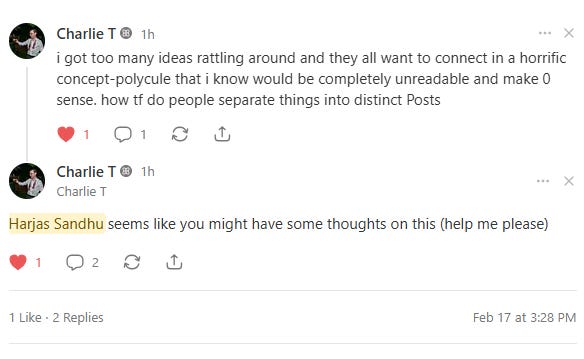
i got too many ideas rattling around and they all want to connect in a horrific concept-polycule that i know would be completely unreadable and make 0 sense. how tf do people separate things into distinct Posts
Harjas Sandhu seems like you might have some thoughts on this (help me please)
Charlie, I’m incredibly flattered that you thought of me. I still don’t think of myself as a writer, so this was a very nice message to receive on a random Tuesday. Let’s do it!
I think the first step is to figure out why you’re writing your article. If you actually just want to describe the concept polycule and how all of the concepts interlink each other and are related, that seems perfectly fine to me. I did reply to your comment and say:
for the record I’ve made a million concept polycules themselves, and I’ve found that it’s impossible to get away with connecting more than 2 completely distinct concepts (MAYBE 3 if you’re skilled and lucky) unless you’re Scott Alexander or something.
The polycules never seem to do better than simple marriages. this says a lot about our society.

But also not everything is supposed to “do better,” whatever the hell that means! If you have an article you really want to write and already have an idea of what the flow and argument might look like, who cares about readability?? It’s your blog!!
Anyway.
Some big and unwieldy articles stem from trying to start an article without a direction or thesis or outline. Your outline doesn’t need to be explicitly laid out in bullet points, but you should mostly know what you want to say (although this can change over time). You can also just bullet-point an outline that basically only consists of the claims you want to make: it’ll help you figure out the approximate shape of the article you want to write. Feel free to include particularly important warrants or evidence so long as you don’t let it get out of hand.
That being said, outlines change as you edit, so don’t take them as gospel. They’re meant to serve you, not the other way around.
Alternatively, if you’re investigating something for a post, you can either figure out the scope of what it is you’re trying to research ahead of time, or you can drop the post entirely and research to your heart’s content until you strike upon something worth writing about, at which point you go back to trying to figure out a direction or thesis or outline.
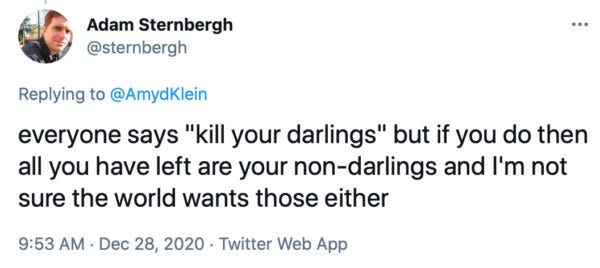
But concept polycules can also start life as a single original idea. Starting with a clear-cut thesis and well-defined scope won’t always save you from going off the rails during the writing process, probably because you’ll probably think more and learn more during the process of research and writing, which will prompt you to write more and research more, which will prompt you to think more and learn more, etc etc. If this is happening to you, you kinda just have to finish out the spiral at an arbitrary point and then go back to kill your darlings.
A trick I got from my boss (who was a journalist for like 30 years) is to have a document for “detritus”. This detritus is stuff you need to cut from the article but can’t bear to part with: sticking it in a separate document can make you feel better about axing it. And if you later realize that you needed that paragraph after all, well, you’ll know where to find it!1 I also regularly leave comments in my documents that say something along the lines of “This paragraph needs to be spun off into its own article,” so that I can later create a new document and move the paragraph there.
In general, having an editing session in which you aren’t allowed to alter text and are only allowed to leave comments from the perspective of an editor is very helpful.
You might need to put a day or two between the writing process and the editing process to get some fresh perspective on the whole thing. Having an outline helps here too, since it serves as a sort of argumentative scaffold: it’s hard to conceptualize an entire article’s worth of logic chains unless they’ve been simplified. Headings and section names—or at least section themes—also help with this. They also come with the added bonus of making the article easier for your reader to conceptualize, which is in some ways the whole point of decomposing your concept polycule.
I personally resolved a lot of these issues when I expanded my writing perspective from “what is the thing I’m trying to describe?” to include “what is the point I want the reader to take away?” and “why should a reader care about what I’m trying to say?” It’s a somewhat subtle shift but it really makes a difference—it allows you to shift from the clingy “I really like this thing and I want to keep it in” mindset into the “wait, but what does this actually do for the article that I’m trying to write?” mindset.
And honestly, sometimes you end up having to murk some really good prose or delete a really good point that you made just because it doesn’t fit. If you go through a writing and editing pass and find that things don’t make sense, you might just have to throw out the baby with the bathwater if it’s not supposed to be there. Nothing you can do about it.
This is really hard to stomach if you don’t already have a lot of writing experience. When I started writing last year, I definitely clung to all of my golden nuggets of good writing. At some point I realized that I was operating from a fear and scarcity mindset. I decided that if I was really worried that I would never be able to write something better in the future, I should probably just quit—an idea which later turned into its own post! Reading it back, I think the post is like eh at best, but that’s the whole point! I don’t know how much you’ve written in the past though, so YMMV.)
Also, you should read this article about why people like quick bullshit takes better than your high-effort posts. The main points:
The quick post is short, the effortpost is long
The quick post is about something interesting, the topic of the effortpost bores most people
The quick post has a fun controversial take, the effortpost is boringly evenhanded or laden with nuance
The quick post is low-context, the effortpost is high-context
The quick post has a casual style, the effortpost is inscrutably formal
It also has this great quote at the end about when not to listen to this advice:
But listen, I bet you’re not just writing to maximize audience. Friend of the blog Ozy Brennan once said that being a writer requires “the absolute conviction that total strangers should listen to you because your words are interesting and valuable” (as well as “the decision to choose a career where you never leave the house or talk to anyone”.)
You’re here to say something interesting and valuable, right? I don’t think you ought to smooth out everything you touch for the masses. You want to say something that only you could say or that will hit the reader who needs it at the right time. You want to impress that one guy at the Blogging Club, or you practice “blogging as warnings scrawled on the cave wall”, or you’re writing for nice future AGIs creating rescue simulations of you based on your digital text corpus. Listen. Don’t lose your mind about it. Just try to say something beautiful and true. Or, failing that, say something fascinating and baffling.
But, I mean, obviously it’d be nice if the masses turn out to want to hear it too. I get it. There’s nuance.
Also consider reading the Tumblr post that inspired it.
Anyway, this is now too long to reasonably be a Substack Note, so I’m gonna go ping you and hope you agree to be mentioned in the article!
Please say yes. I worked so hard on this post, Charlie. Please.
Oh, I almost forgot the most important piece of advice: talk to someone about the thing! I find that confusing concepts become so much cleaner once you have to explain it to someone. You also get to see what is and isn’t confusing in real time, which is very nice.
this has literally never happened to me before.

but what if tho
forgot to include in main body but Charlie did say yes. Yippee! https://substack.com/@hardlyworking1/note/c-215965220?utm_source=notes-share-action&r=40ph79
tysm this is very cool + helpful!! Outlines + a phrase junkyard (detritus) are part of how I work but I think the thing I'm missing (at least on current Post attempt) is the central thesis to work back from... much to consider