
Some alternatives to "It's not X; it's Y"
Stop using ChatGPT's favorite phrase

I.
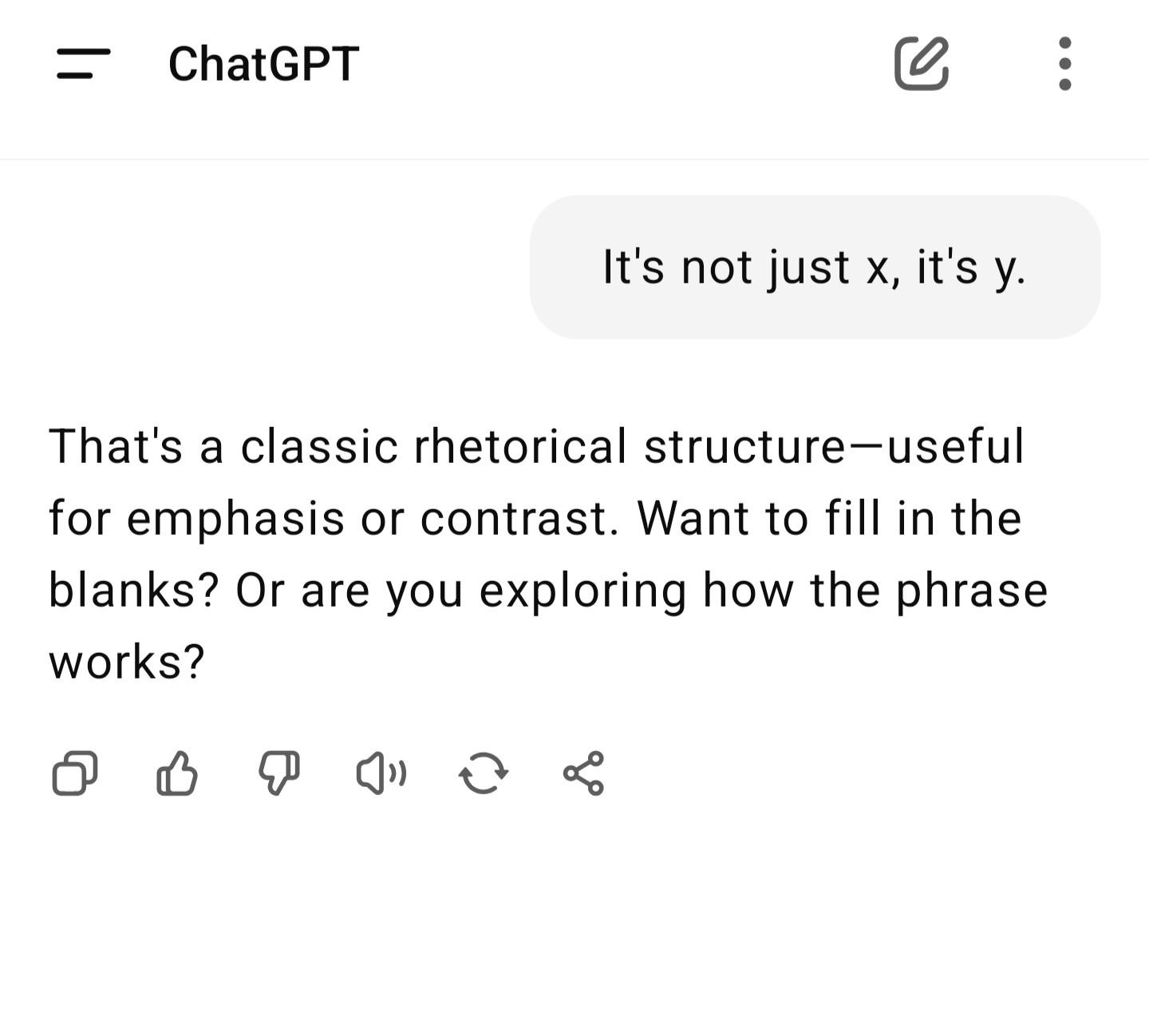
Listen y’all. It’s the big freaking ‘26. “It’s not X; it’s Y” is the single biggest tell that a piece of writing was written by ChatGPT. Everyone knows.
And while The Phrase was probably a good writing phrase at some point, it’s become so overused that even seeing it in a piece (or worse, hearing it out loud)1 will immediately make me drop whatever it is I’m reading (or watching) and switch to something else.
If you’re a writer who reads stuff online, this might be causing some problems for you. Specifically, you might have liked The Phrase, and for good reason. It’s not stupid; it’s concise. (Ew!) And now, you have to look for some phrases to replace it with to avoid looking like you’re poisoning the town square.
If this is you, I absolutely get it. I’ve been cooking this in the lab for a while—this isn’t the first time I’ve thought about writing in the age of AI—but last time, the advice was more general. This time, I want to specifically talk about ChatGPT’s most overused phrase, and how to avoid it in your own writing.
II.
The first thing I want to call out; this type of phrase is kinda useful. Despite my ribbing from earlier, The Phrase is concise, and it was probably pretty stylish before it got overused. And check out that last sentence—doesn’t it feel better than how “it’s not stupid; it’s concise” sounds?
The Phrase appeals to writers in large part because it immediately signposts the writer’s main point. You set an expectation up—your proverbial “X”—and then proceed to negate that “X” with your solution, your “Y.” And when a reader reads The Phrase, they immediately understand what they do and do not believe in or agree with. By comparing your point to its opposite, you add emphasis to your writing, a rhetorical technique I’ve heard referred to as “contrastive antithesis.”
But interestingly, ChatGPT also seems to love a sub-variant of The Phrase that negates the purpose I just described. Sometimes, instead of writing “it’s not X; it’s Y,” it’ll make a key change and write “it’s not just X; it’s also Y.”
It’s incredibly easy to find an alternative to the latter version of The Phrase. “It’s not just X; it’s also Y” is clearly just another way of saying “it’s both X and Y.” You would only use the former construction if you wanted your writing to sound snappier or punchier or assertive-er without actually adding more to it.
Because instead of saying “it’s not just lazy; it’s also emotionally manipulative,” I could instead just say:
This construction is both lazy and emotionally manipulative. (Simplest form.)
This construction is emotionally manipulative. It’s also just lazy. (Punchier version.)
Lazy writers use this construction to emotionally manipulate you. (Centering the sentence around a new subject—”writers”—and also insulting them by doing so.)
Emotionally manipulative writers use this construction when they’re being lazy. (Same as before, but focusing on “emotionally manipulative” as the key trait and putting “lazy” at the end.)
If you use this construction, you’re probably trying to emotionally manipulate your audience without putting in enough work to deserve it. (Addressing the reader directly, and importantly, not even saying the word lazy because it’s not really necessary!)
And once you understand these points—particularly that last one—“fixing” ChatGPT’s favorite phrase becomes really easy. If you can get over yourself, you can say simple sentences like “I prefer Y over X,” or “I think Y is correct. Conversely, x is incorrect,” or, best of all, “I think Y,” all while avoiding sounding like a pretentious dork. And if your writing can be phrased like that last variant without losing any meaning, you may have included a meaningless counterexample just to provide contrast. Stop it.
III.
This is a pretty short post. That’s because this is an easy problem to solve.
In my own writing, I’ve noticed a consistent pattern; I only really use The Phrase when I feel like I have something to say, don’t exactly know what that is, and cop out by reaching for a punchy shortcut.
Accordingly, every time I notice The Phrase in my own writing, I go “drat. Not again…” and immediately clean it up to be more clear (and also less full of hot air).
I’m not saying you should never use The Phrase. I personally don’t use it anymore, because I have a pretty low tolerance for ChatGPT generated writing, but contrastive antithesis is part of ChatGPT’s lexicon for a reason. Now, I wish I could tell you what that reason actually is—if I had to guess, it’s probably a combination of seeing it a lot during pre-training, and then being conditioned to prefer it during the reinforcement learning phrase (when humans give feedback on what version of ChatGPT’s writing they prefer), because of course, ChatGPT represents the average human’s reading preferences during the time of training. That’s also why it’s sycophantic.
But of course, human preferences change over time; what people prefer today will probably be subtly different from what they prefer tomorrow. Better yet, human preferences are malleable; I would be willing to bet that people dislike The Phrase more today than they did ten years ago because The Phrase went mainstream and thus lost all its luster. A full accounting of cultural evolution is beyond the scope of this post, but it will suffice to say that niche things gain prominence, become overused, and then fall out of fashion all the time. And because ChatGPT gets updated every so often, it might stop using The Phrase once we do.
So the drive to express something is the key, more important than any particular writing trick, tip, or phrase. If you don’t have anything important to say, none of those things will save you. And if you do have something important to say, replacing stupid or unclear phrases is pretty easy: all you have to do is think for long enough and you’ll figure it out.
Try as it might, modern LLMs still struggle to express clear distinct points or unique and particular opinions. That’s because they aren’t people. An LLM lacks a world model, and regularly hallucinates because it doesn’t have a point of view to begin with. These limitations place a hard cap on how good an LLM can be at writing. If a writer doesn’t really understand the truth of what they’re saying, how could they possibly choose between the infinite different ways to say what they want to say?
The real key to not sounding like a stupid bot is leaning into the fact that you are a person. Focus less on the use or overuse of particular phrases (though the specific tips I gave will work) and focus more on what exactly it is you’re trying to communicate. Writing is a skill and phrasing takes practice, but if you know what you want to say and really really want to say it, the rest will take care of itself. Good luck, and happy writing!
Honestly, this phrase kind of sounds fine IRL if you don’t say it with an “um, ACKTUALLY” vibe.
Is the mother not the classic breakup line “its not you, its me”?
Every time I see this construction in a piece, or catch myself writing it, I’m reminded of the ancient phrase that birthed it (probably not but my life it did):
It's not delivery; it’s DiGiorno.