
It's probably not as bad as you think
Just time yourself

Dear [steadfast Hardly Working Reader],
I.
You know that thing you need to do? The one you’ve been putting off? The one that sank deep into the recesses of your crusty brain until it metamorphosed into an inconspicuous tumbleweed in the background of your psychological landscape?
How long do you think it’s gonna take you?
Do you actually believe your answer?
II.
I don’t. Believe my own answer, that is. I know my brain does funny things with time.
Consider the Marshmallow Test, a test of impulse control and delayed gratification. Basically, some researchers offered some children the choice between one marshmallow now or two marshmallows later. The researchers then followed those children into adulthood and found that self-control in the Marshmallow Test was predictive of future success in adulthood because “self-control good,” or something.
While the core finding of the original test has been debunked—as it turns out, the average kid who passed the Marshmallow Test didn’t end up any better or worse than the average kid who failed it1—the test does explore an interesting facet of human nature: we sometimes prefer small reward now over big reward later, even if big reward is guaranteed.
And yes, the replication study did confirm that the participants would prefer the larger reward.
The experimenter presented the child with both a smaller and larger amount of the treat and verified that the child preferred the larger amount.
Annoying economists call this phenomenon hyperbolic discounting.2
Now, to be fair: that replication study ran the Marshmallow test on children, who presumably have worse self-control than adults. And somewhat surprisingly, 56% of them passed!
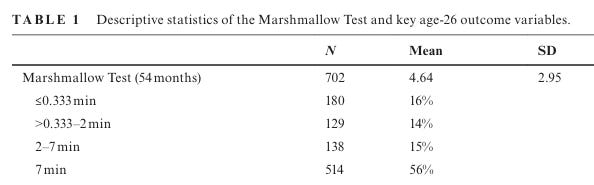
How well can we extrapolate results from tests run on children precisely 54 months of age? I’m not sure. Also: for some reason, no one’s ever thought to run the Marshmallow Test on adults.3
However, I’m pretty sure this finding generalizes broadly. You definitely know people who have impulse control issues; hell, if you’re reading this article, you probably struggle with delayed gratification yourself. If I didn’t suffer from hyperbolic discounting, my room would be clean and my dishes would be done and my apartment would be fully unpacked and organized. Clearly I have some issues with weakness of the will.
But I think procrastination is about more than simple weakness of the will. Hyperbolic discounting probably does exist even when viewing situations clearly but I also think my brain actively alters my perception to favor immediacy over pure expected value, by making expected rewards feel smaller and making expected costs feel larger. If I was placed in a Marshmallow Test, my brain could very easily make the waiting period feel longer in anticipation than in reality—and make me fail the test accordingly.
So, if you’re willing to indulge me, let’s revisit that question from section I. Think about that task you really don’t want to do; guess how long it’ll take you to do; then time yourself and see how long it actually takes.
Alternatively, guess how much progress you can make in some fixed amount of time—five minutes, 15 minutes, an hour, whatever—and then verify whether your brain is messing with you.
I think the results will surprise you. But I don’t want to ask you to go first: you know, reciprocity and all that. So, I’m going to test both options myself and report back with my findings.
III.
The last few times I tried option one, I vastly overshot my time estimate. My rote chores feel so long while I’m thinking about doing them, but when I actually do them, they’re basically always shorter than expected.
So, this time, I was surprised to find that my task (writing some stupid document) did take me as long as I had expected (two hours).
However, this task did take less energy than I’d expected. I was kinda chilling the whole time; I think I could’ve finished in less than an hour if I’d actually locked in. In hindsight, I probably should have known that I would be energized by writing, even if I was half-assing it for two whole hours; I think I’d assumed that the task would be laborious simply because it was long. Apparently that’s not a safe assumption.
So what did I learn?
My time calibration for writing is actually not that bad. I expected two hours, and that’s how long it took.
My effort calibration could use some work. Writing does take focus, but it doesn’t require that much focus; to put it another way, I am capable of writing while mildly distracted.
Effort and time are not independent variables. Sometimes, you actually CAN cut down on task completion time just by trying harder. (Duh.)
My suckiness calibration is horrible. I really did not want to start that task, but once I did, it was completely fine and actually kinda fun.
Onto option 2!
IV.
Once again, this did not go how I thought it would.
Some backstory on task two: I started learning Japanese a couple months ago using Wanikani.4 Language learning is very fun, but it’s very time-consuming. It also takes constant maintenance, a lesson I learned after skipping my reviews for a few short days and returning to the app only to find a distressingly large flashcard review backlog. I had no idea how long it would take to clear, and honestly, I was starting to hate even looking at the hundreds of uncleared words in the pile.
So that was task two: clear out my review pile. I didn’t want to do the whole thing in one sitting, so I set a 20-minute timer and went for it.
Just like last time, I was expecting the task to be shorter than I expected. But 20 minutes in, I realized I wasn’t even halfway through the backlog! After those 20 minutes, I was curious to see how long the rest would take, and so I went for it: it ended up taking 25 minutes. I guess reviewing Japanese vocabulary takes longer than I’d thought.
So what did I learn?
My time calibration for language learning is horrible. Serious language learning work is a serious time commitment!
My effort calibration for language learning is horrible. I was pretty focused during those 45 minutes, and I’m a little unfocused now that I’ve finished, but I was expecting to be tired and I’m not tired at all. It seems like focusing isn’t an intrinsically tiring activity, which is a surprising realization.
I should probably pay more attention to my feelings of apprehension: if I’d listened to them earlier, I might’ve started my reviews earlier and saved myself the hassle of clearing a big pile all at once.
My suckiness calibration is still incredibly off. I thought those 20 minutes were gonna suck. But then the task took 45 minutes, AND it was fun to do.
V.
That last bullet might be my most important takeaway from this whole experiment.
See, I’m used to ignoring my feelings of apprehension and avoidance. That’s because I associate those feelings with a “not doing task” mindset; after all, those feelings—and that mindset—are precisely what I use these timers to avoid. But I’m now beginning to realize that ignorance just leads to further miscalibration. If I teach my brain to get better at predicting how effortful, time-consuming, and arduous a task really is, I won’t have to spend so much time trying to overcome those negative feelings. And of course, doing so begins with finding out what it really feels like.
Will these methods change your life? Maybe. They’ve been very helpful for me, but I’ve also been writing this post as an excuse to put off the truest arduous task that’s been looming over me for the past two months (unpacking 🤢). They’re probably not silver bullets in and of themselves.
But the principles behind these methods have changed my life. As I’ve been finding out over the past year, adulthood consists of infinite housekeeping and chore maintenance; I’ll literally never be able to fully clear my to-do list, and at some point I just have to accept that I’ll never sort my life out. Since I don’t have infinite time, it’s nice to know how long it actually takes to do things—and relatedly, how much I can get done in a given period of time. It’s also nice to do something I’m apprehensive about and find out that it’s chill; alternatively, it’s nice to find out that it really sucks, and that I should actually be willing to put far more effort into avoiding it.
I can’t do everything. No one can. But I can build a better relationship with “work” and “tasks” and “time,” and so can you. It’s not that difficult; all you have to do is set a stopwatch and get to work. And if you want, you can even do that right now.
If you do: let me know how it goes!5
Thanks to Charlie T for giving feedback on an initial draft of this post.
For more on the Marshmallow Test, consider reading this excellently titled paper: “Delay of gratification and adult outcomes: The Marshmallow Test does not reliably predict adult functioning.”
Cool economists also call it hyperbolic discounting.
If you have or know someone who has, please let me know!
WaniKani a cool Japanese-only spaced-repetition learning app, which is exactly my style. Also, this is not a paid sponsorship. WaniKani people, hit me up!
If you’re willing to leave a comment, I’d love to read it. But also, if you’re reading this from your email and don’t want to comment on Substack, you can also just reply to message with an email of your own! I think. I guess I’ve never tested it out before…
I love your experiments (and the results are very relatable). For a while I was using Brili for something similar (it basically breaks down each bit of a chore (e.g. morning routine or cleaning the bathroom) and estimates time, and you get to see how long it actually takes as you do it).
Suffice to say it was very surprising to me how my brain estimated stuff vs reality!
This motivated me to start working on my final project today