
What does it feel like?

When you wake up this morning, the first thing you realize is that you feel like garbage.
You scrabble around for your phone and play a YouTube video as you stumble to the bathroom, shuffling through your morning routine like a zombie until that first miraculous sip of coffee hits your taste buds. You’re still tired, though. You feel it in your bones.
You’re almost late for the train, but you make it in time. Public transportation annihilates space with time, but that’s not enough for you, who must also annihilate your sense of time by killing your consciousness. You spend 15 minutes hoarding articles on Substack, scrolling through TikTok, playing games on Clash Royale or the New York Times or some other app of your choice.
You get to work. It’s a quiet day, with no deadlines approaching. You scroll Twitter until you find someone to argue with while frantically making sure no one is looking at your screen. The minutes drag, but the hours go by in a flash. You suddenly realize that your coworkers are packing their bags and heading home. You join them.
On the way back, the coffee wears off. You’re tired again, and lonely too. You put on your favorite podcast, probably four guys hanging out in an attic or something, and try not to think about the emptiness of your apartment.
You get home and start scrolling. An hour passes in a flash as you send dozens of Instagram Reels to your friends. Most are funny, some are interesting, a couple make you feel worse about the world. You hate feeling like you’ve wasted the day, so you snap out of it long enough to do one good thing for yourself. Then you eat some cold leftovers and get ready for bed. Oh, and you bring a speaker to the bathroom when you shower. Showering without music is too boring.
It’s finally time for bed. You suffer through an hour of revenge bedtime procrastination before the panic kicks in. You put your phone away, but now your mind is racing and you’re too anxious to fall asleep. You find a soothing audiobook and pass out. You wake up tomorrow and do it again.
Do you really hate being conscious this much?
Do you hate being alive?
When you smooth over the consequences of your actions, you dissociate from the laws of cause and effect. You wake up feeling like garbage because you didn’t sleep enough, you waste time at work because you hate feeling bored, you’re anxious about feeling lonely because you don’t spend time strengthening your relationships, your mind races when you try to fall asleep because it’s the first time today that you haven’t been inundated with stimulus. You don’t really want to live like this—if you actually didn’t care, you wouldn’t try to numb the pain.
But when you numb the pain, you forget how to feel. You stumble through the jungle of your cravings, hacking down negative emotions and sensations as soon as they arise, desperately clinging to the highs of life. You spend all day trying to kill your consciousness and sometimes you even succeed. You reduce your sensitivity to life; you reduce your ability to tolerate distress or handle negative emotions; you learn how to numb your mind pain. You know that what you’re doing is bad for you, and you try to convince yourself that you don’t care. It doesn’t work.
And then you wake up tomorrow and do it again.
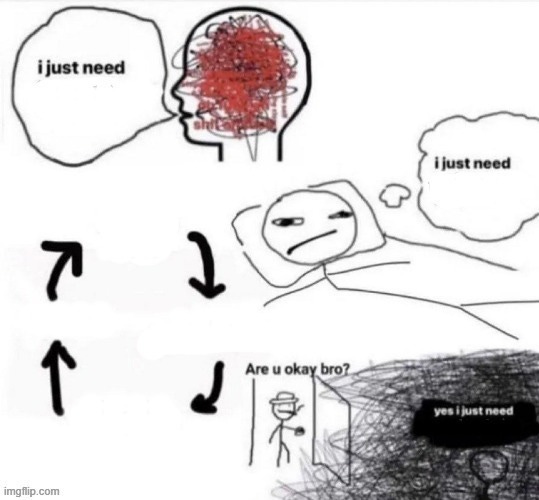
This essay was largely inspired by the essay Learning to Feel and Be With Oneself from this book (emphasis mine):
How does your body-mind feel first thing in the morning? Learn to feel that rather than just thinking, ‘I don’t feel so good. I don’t feel very much awake. I feel I could use a stiff cup of coffee or stay a few more hours in bed.’ That’s what happens when we think about suffering: we think of the antidotes to it, so of course if we don’t get them, this suffering becomes worse and worse, doesn’t it? We continually limit ourselves. But how does it actually feel? Are we prepared to go through the experience of waking up, the feeling of dullness, the feeling of hunger, the feeling of tiredness? What do they actually feel like?
along with another book by the same author called Turning the Wheel of Truth (which is where the jungle metaphor comes from, emphasis mine again):1
“We stumble through our jungle of craving, either suppressing a habit or replacing it with another in order to cope with our addictive tendencies. It takes encouragement and skill to look into the very nature of need and craving—to see how we fill our hunger with something to eat, drink, read, or talk about. This is the penetrative inquiry that is the way out of our inner jungle.”
As I’ve tried to shift from ignorance to wisdom, doing my best to translate the intellectual insights into cycles and negativity into actions that bring about good consequences,2 I’ve slowly begun to realize how much of my day is an attempt to escape something, even if it doesn’t always feel that way. Especially when it doesn’t feel that way.
And interestingly, this penetrative inquiry isn’t complicated. Uncomfortable, often; difficult, sometimes; but it is also as simple and honest as the truth. I myself am still trying to figure it out—I’m no expert on Buddhism—and I hope to write more about it in the future.
The first part of this essay is an amalgam of cycles I’ve either seen or heard about from others. Many of the key anecdotes—the bit about the morning (save for the coffee), the emptiness of an apartment (especially when roommates aren’t present), and the revenge bedtime procrastination—come directly from my own life. I’m no better than anyone, and I’m writing this post for one simple reason: I truly believe that we don’t have to live like this.
There is a path out of the jungle. Following that path leads to a version of you that is okay with suffering and is simply happy and grateful to be alive and present. I’ve caught glimpses of it in my own life and practice, and I think you probably have too. Regardless of creed or religion or lack thereof, sometimes life shows you a moment of serenity without craving seemingly just to remind you that it’s possible. And it is. But this is a topic for another time, and it’s a topic that is currently beyond my capability to describe, at least from my own personal experiences. For now, I guess I’m asking you to try slowing down.
The next time you find yourself in one of these situations, take a moment to breathe. Notice the sensations in your body. Notice how the cravings arise in your mind. Notice the things you cling to for comfort—concepts, worldviews, mantras. Think less about trying to find a “solution” and more about what the “problem” actually is—and once you decide to address the problem, spend some time with your “solution” and see if it’s also a craving or clinging. Be generous and patient and honest: this stuff is hard, but it’s worth it.
Above all else, ask yourself: what does it feel like?
I’ve been reading this book on and off for the past year and a half, and it’s made a huge impact on my life and psyche. It’ll definitely get a book review at some point. For now, I highly recommend it!
I’ve been saying “cause and effect” or “consequences” instead of “karma” because I want to avoid the metaphysical notions of birth and rebirth inherent in that word. Still, I think about it as karma in my head now, because “will this action generate good karma” is much easier for me to parse than “what is the expected value of this action”
Damn. That description at the beginning ... "do you hate being alive this much" really says it all.
There is no way to numb out the negative without also shutting yourself off to aliveness and vitality. There are exceptions, but by and large the "feelings" button is an on/off switch...
I was surprised this didn't have more likes and comments! Excellent read and exactly how I have been feeling for a long, long time. Too long.